The accountancy profession – despite its ubiquity and critical role at the heart of business, public services, and financial systems – remains under-leveraged, often misunderstood and facing disruption to its business model, identity, and appeal. While the business world turns to innovation, purpose, and performance, the profession must now reclaim its identity as a catalyst for trust, sustainability, and navigation of complexity to deliver long-term value creation.
That is the opportunity we must seize. It is precisely what we confronted at the recent meeting of IFAC’s Professional Accountants in Business (PAIB) Advisory Group, hosted by the Japanese Institute of Certified Public Accountants (JICPA) in Tokyo. With members and guests participating from across the globe, the meeting served as a platform for strategic dialogue on how accountants can help shape the future of business and unlock their full impact. During this engaging two-day meeting we explored and challenged one another on some of the most pressing and fast-evolving priorities facing both business and the profession.
In a rapidly emerging new world order, defined by increasing geopolitical tensions, shifting trade policies, accelerating technological disruption, and growing climate and sustainability pressures, businesses are dealing with unprecedented complexity. ACCA’s Chief Economist, Jonathan Ashworth, provided a global economic overview and a cautiously optimistic forecast for 2025, marked by modest growth and persistent uncertainties.
In our regional breakout discussions, it was clear that there are different perspectives and priorities in dealing with global developments on tariffs, trade, energy, security, AI, and regulation. But in an increasingly fragmented world, the profession has a key role in maintaining global connectivity, and is vital in shaping sustainable, inclusive, and resilient organisations and economies. Accountants must guide organisations through uncertainty with strategic foresight, scenario planning, adaptability, and a deep understanding of emerging regional and global dynamics.
Four themes emerged on how we need to be proactive to position accountants at the forefront of business transformation:
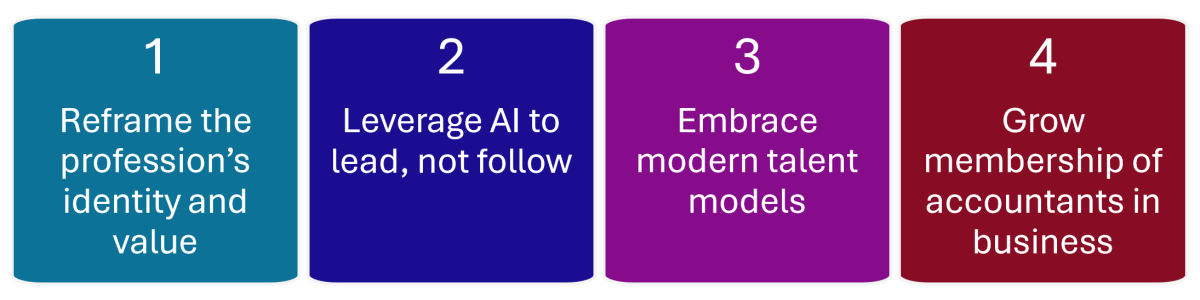
1. Reframe the profession’s identity and value
Outdated perceptions of accountants as scorekeepers do not reflect the varied and impactful roles accountants perform in strategic and operational business partnerships. Across jurisdictions, a radical repositioning is needed, one that positions accountants with modern roles enhanced by AI and rooted in purpose, ethics, and value creation. This means updating imagery (ask ChatGPT to give you an image of an accountant – it’ll likely be a male in a suit and tie with glasses and a calculator), as well as language, including titles and career pathways (such as a shift from Chief Financial Officer to “Chief Value Officer”). Most accountants in business do not have ‘accountant’ in their job title! The profession must also better market itself as a launchpad for careers in business, entrepreneurship, sustainability, and leadership.
“AI is moving fast, and the profession cannot approach it with solely a compliance and control mindset.”
A compliance-driven mindset is giving way to new practices and approaches that drive decision making and performance including:
- Advancing risk management and culture: In a volatile environment, a strong risk culture is essential. It equips organizations to respond quickly to emerging threats by embedding risk into decision-making, aligning behaviors with risk appetite, and fostering cross-functional awareness and leadership coordination. Risk culture is a strategic imperative. With growing pressure from regulators, investors, and society, organizations must move beyond static risk assessments toward a more responsive, dynamic, and embedded risk management approach. This means empowering people across the business to understand, own, and respond to risk in real time. Aligning risk reporting with effective risk management practices provides greater value to investors and organizations, ensuring that disclosure is not just a compliance exercise divorced from the reality of the business. READ MORE: Advancing Risk Management and Culture: Connecting Disclosure to Strategic Decision-Making
- Embedding integrated thinking and focusing on what matters. As sustainability reporting becomes mandatory in many jurisdictions, there is a growing risk that companies approach it with a compliance mindset. However, integrated thinking remains essential for meaningful disclosure, linking sustainability risks and opportunities to long-term value. Organizations must start by focusing on the issues and risks that truly matter to their business, using this as the basis for strategy and, in turn, reporting. This means applying integrated thinking, which requires integrated governance, controls, reporting, and assurance. Integrated thinking is the foundation for navigating today’s complex business environment. It enables companies to respond to constant real-world and regulatory change with clarity and purpose, while providing investors with meaningful insights into the true drivers of value and risk.
Japan is a leading example of how integrated governance and reporting can drive sustainable corporate growth. Through reforms such as its corporate governance and investor stewardship codes, Japan encourages long-term value creation, board accountability, and active investor engagement. Over 1,000 companies now publish integrated reports, many using the International Integrated Reporting Framework. With the rollout of new sustainability disclosure standards aligned with the ISSB global baseline, Japan is embedding sustainability into corporate decision-making and positioning its companies for global comparability, assurance, and investor confidence. These developments are also driving changes to CFO roles to be more focused on strategies for capital allocation and efficiency and the drivers of corporate value in the medium and long term.
2. Leverage AI to lead, not follow
AI is reshaping how businesses operate and how work gets done, with AI-empowered and tech-enabled finance and accounting professionals creating insight and value. The profession must shift from reacting to developments to proactive leadership in AI. AI is a systemic shift already transforming all roles and accountants are using AI in a variety of ways to deliver insights that elevate, not replace, their professional judgment.
To remain relevant, accountants must develop not only AI literacy but fluency. This means learning to utilise AI tools with purpose to enhance decisions, create impact, and build trust. The future-ready accountant is not waiting for change, they are designing it. And organisations must urgently empower them to do so. A key risk is not the AI itself, but the gap between accountants who use AI and those who don’t. AI represents a fundamental shift in workflows and business processes, which means it must be a core part of an accountant’s skillset, not something optional or add-on.
The reality is that AI is moving fast, and the profession cannot approach it with solely a compliance and control mindset. Accountants need practical, forward-looking support from the profession, including timely guidance, modernized learning pathways, and access to tools and networks that help them keep pace with rapidly evolving technologies and expectations.
3. Embrace modern talent models
Younger generations increasingly seek careers with purpose, flexibility, and innovation. ACCA’s latest research Global Talent Trends 2025 highlights growing interest in sustainability-related careers, rising entrepreneurial ambition and a side-hustle culture (as a way to earn extra income outside of a main job). In response to these trends, the profession needs to explore more flexible pathways, including enabling non-accountants to gain financial skills.
“Accountants must guide organisations through uncertainty with strategic foresight, scenario planning, adaptability, and a deep understanding of emerging regional and global dynamics.”
The PAIB Advisory Group identified the following suggestions to increase accessibility and flexibility:
- Micro-credentials & modular pathways: Modular, stackable learning that allows individuals to build credentials incrementally, enabling entry from a variety of educational or professional backgrounds (school leavers, mid-career changers, etc.).
- Flexible & tailored curriculum: Allow students to specialize (e.g., in sustainability or business advisory) without forcing mastery of all traditional subjects like tax or audit unless relevant to their role.
- Internship and entrepreneurial training: Build in real-world exposure to operations, entrepreneurship, and AI tools so that students gain practical experience.
- Global mobility and recognition: New thinking is needed on how to improve cross-border mobility for accountants. Borderless credibility is essential to growing a global and connected profession.
- Preserve core values and skills with modern structure: While flexibility is key, it is important to retain foundational ethics, integrity, and core technical and analytical skills.
4. Grow membership of accountants in business
Structural barriers in governance, qualification systems, and legislation continue to limit the growth of PAIB membership of PAOs in many jurisdictions. Expanding membership of accountants in business and the public sector needs to be a key strategic priority for the profession if it is to continue its growth and expand its influence. It’s not just about more accountants, but about accountants who are prepared for new and evolving roles. We’ve got to expand our profession, whether it is in size or relevance, both are critical.
Next steps
To grow the profession, we must be bold. That means expanding the pipeline of accountants to reach beyond today’s 4 million, while also expanding the definition of what an accountant can be and where they can lead. We must position accountancy as a dynamic, high-impact career for the next generation: one that is rooted in ethics, fluent in technology, and influential in shaping sustainable businesses and public outcomes.
This journey requires moving beyond legacy models and embracing transformational, not incremental, change. It calls for deep collaboration across business, government, standard-setters, and education providers to reshape how the profession is perceived and what it delivers.
The PAIB Advisory Group will continue to lead this agenda, putting forward bold and actionable recommendations that expand the profession’s relevance, reach and influence in a rapidly changing world.
Sanjay Rughani serves as the chair of IFAC’s Professional Accountants in Business advisory group.
This article originally appeared on the IFAC Knowledge Gateway. Copyright © 2025 by the International Federation of Accountants (IFAC). All rights reserved. Used with permission of IFAC. Contact permissions@ifac.org for permission to reproduce, store, or transmit this document.
Interested in bolstering your strategic advisory skillset? The IPA Program is designed with that in mind. Learn more here.