At a glance
- A new AI-driven ledger promises to automate bookkeeping with very high accuracy.
- Its unique data model gives it context and classification accuracy.
- The system automatically reconciles 95% of transactions, flagging outliers for human review.
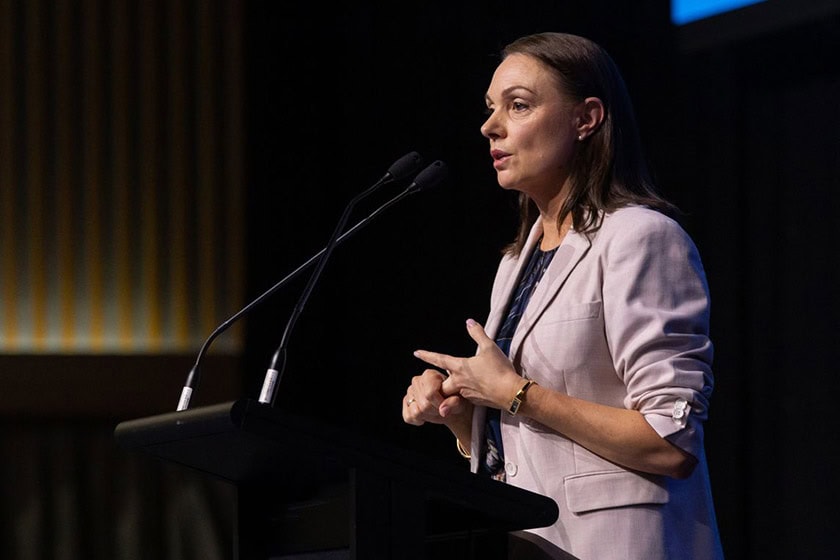
ATO second commissioner Kirsten Fish has signalled the ATO is determined to rein in small business infractions like late lodgement, as it works to shrink the small business “tax gap”.
Fish told the opening day of the IPA National Congress on Thursday 20 November that the small business tax gap continues to be the largest piece of Australia’s overall tax gap. And she provided a string of statistics to justify the ATO’s stance on small business tax payment.
But Fish also foreshadowed changes to the ATO’s treatment of the general interest charge (GIC) in response to criticism. “Rest assured, we’ve heard you,” she said.
Shrinking the small business tax gap
Fish opened her speech to IPA members by acknowledging their role. And she said the ATO knows that most small businesses try to do the right thing: “The majority of small businesses lodge on time and pay on time.” Small businesses who engaged regularly with tax professionals were far more likely to report correctly and avoid debt. And “trusted advice is one of the three common elements among successful small businesses.”
But like other tax authorities around the world, the ATO is battling to reduce the small business tax gap. This is the gap between what the tax authorities believe they should be collecting, and what they actually do collect in a particular area.
“The ATO is taking firm action where we see deliberate choices that create an uneven playing field”
– Kirsten Fish
Figures released this month confirm that in 2022-23, small business was collectively paying only 82.6 cents for every dollar they owe the ATO. The gap appears to have blown out in the wake of the COVID pandemic in the early 2020s, when authorities eased off their pursuit of late payments.
The ATO began to focus on shrinking the small business tax gap at least as early as 2022. But Fish’s speech suggests it is not yet satisfied that payments are flowing as they should.
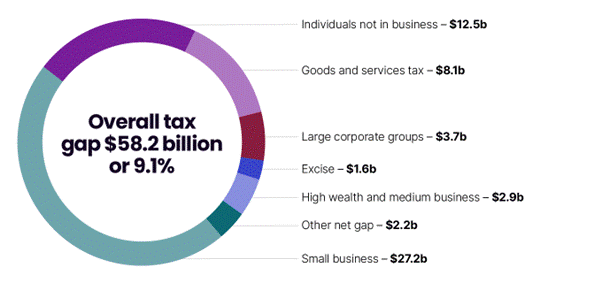
The ATO estimates that in 2022-23, the small business tax gap was$27.2 billion. That was more than seven times the size of the tax gap for large corporates, a group that includes BHP and the Big Four banks.
Those 2022-23 tax gap figures, released a few weeks ago, are the most recent the ATO has published.
ATO estimates of 2022-23 tax gaps
Source: ATO, Tax gap program summary findings, ato.gov.au, updated 3 November 2025
Fish, who heads the ATO’s law, design and practice group, provided a stream of statistics (presumably all from 2022-23) suggesting why small business tax is an ATO priority:
- 47% of the $58.2 billion total 2022-23 tax gap was due to the shortfall in small business income tax payments.
- That small business income tax gap had grown over two years from 15.0% to 17.4% of tax owed, or $27.2 billion.
- The 2022-23 net GST gap was $8.1 billion, or 9.1% of expected GST collections – “and we know that small businesses are also responsible for more than half of this amount”.
- Just under 70% of small business tax obligations were paid on time, compared to nearly 90% across the broader taxpayer population.
- Small businesses owed approximately $35.9 billion in collectable debt – about 66% of the ATO’s total collectable debt book.
- $26.6 billion (70%) of this small business debt was self-reported activity statement debt and the superannuation guarantee charge.
- 67% of the small business tax gap was due to omitted income, 25% to overclaimed deductions, and 7% to businesses operating outside of the system.
The second commissioner called that last 7% “a concerning trend” and “something we are particularly focused on”. She said it was attributable to businesses running cash-only operations, failing to register, or ignoring their tax obligations. “The ATO is taking firm action where we see deliberate choices that create an uneven playing field for those doing the right thing,” she said.
She mentioned three types of businesses that the ATO was looking at:
- ride-sourcing services (including Uber, taxis and limousine services), where the ATO wants to see more compliance with GST registration rules;
- contractors, to match income through the Taxable Payments Reporting System; and
- businesses in the property and construction industry with recurring compliance issues like omitting sales income, overclaiming expenses, incorrect claims for the R&D tax incentive, and failing to register for GST.
The pursuit of timeliness
Fish provided three reasons for the ATO’s pursuit of timely returns and payments:
- Late lodgement is not just a minor inconvenience; it directly impacts government’s ability to fund vital services.
- The interest and penalty regime exists “to compensate government and the broader community for late payments of tax.”
- Early intervention matters. Fish cited 638,000 active payment plans, two-thirds of them held by small businesses. Proactive guidance, SMS nudges, and tailored support are standard ATO tactics to promote self-correction and engagement now.
Fish noted that since April, the ATO has been moving about 2,000 small businesses with “persistent compliance problems” from quarterly to monthly GST reporting. The aim: “to help those businesses embed better business habits and improve in alignment with their regular cadence of reconciliation.”
She advised practitioners to nudge clients toward practices like employing software, keeping good records, and setting aside funds for ATO obligations.
Fish also warned that businesses that don’t engage with the ATO over tax issues, or deliberately avoid payment, would face “more decisive actions”, including director penalty notices, garnishees, and disclosure to credit reporting bureaus.
GIC: reforms coming
However, Fish also revealed that in January 2026 the ATO would be making a number of changes to the operation of its general interest charge (GIC). The ATO adds the GIC to overdue tax debts to encourage payment; it has been toughening its GIC rules, including removing the charge’s tax-deductibility.
Those recent changes have attracted criticism from the IPA and other organisations, and the Tax Ombudsman is in the later stages of a review.
Fish said the ATO received more than 125,000 requests for remission of (that is, relief from) the GIC last year, and had granted 76% of them.
But she also said the ATO had “heard the feedback from the tax practitioner community about our processes,” including the timeliness of decisions on remission requests, insufficient explanation, and inconsistency in decision making.
The changes would include:
- improving online guidance;
- introducing standardised application forms;
- limiting phone approvals to $2,500;
- transitioning agent remission requests to Online Services for Agents; and
- establishing a specialised workforce to manage remission applications.
“We believe these process improvements will address many of the concerns raised with us,” Fish said.
No experienced agents on the phone
During question time, Fish defended the ATO against the claim that it should route tax agents’ calls directly to experienced agents. Among those to recommend such a move is the Tax Ombudsman, Ruth Own, who included it in a recent review.
“I do acknowledge that we don’t hire qualified tax professionals to answer the phone,” Fish said. “We provide a phone service that is for the broader community.” And she said the ATO’s strategy was for a digital-first future: “We want our interactions primarily digital – with agents and the rest of the community.”
Fish listed two projects which she said were under investigation to help solve more complicated queries:
- a secured two-way messaging function that would allow “more complex interactions” to be resolved in a digital, authenticated environment; and
- “an AI kind of chat function which will sit over our website”, which would let the ATO incorporate more technical and more complicated information into its website.
She noted that “tax agents’ work is complex, and it’s complicated, and we understand that you need support from us in order to execute on that.”
Payday super: preparing for change
Major changes to the payday super system will go live on 1 July 2026. Under the new system, businesses will need to pay – and report – employee superannuation with each pay cycle, not quarterly. For practitioners, her practical advice was to:
- Encourage employers to move now to regular weekly, fortnightly, or monthly payments.
- Verify employee super data, reviewing governance and assurance processes.
- Plan for cash flow impacts well before the change.
Fish said the ATO is working with payroll software providers and super funds to have reporting ready. And direct communication has started with users of the Small Business Superannuation Clearing House, which is shutting down. By Fish’s estimate, “85% of businesses using the clearing house already have software that can do the same thing.” But 250,000 small businesses will need new solutions as the clearing house closes.
Fish flagged a practical compliance guideline already circulated for feedback. In year one, the ATO will focus on those failing to pay super at all, or making no “genuine attempt” to shift their payment cadence. Genuine effort will count; those who “show a genuine attempt to meet the new obligations” will be treated equitably.
The ATO’s future is digital tax
Fish painted a picture of Australia’s tax system in which the system continues to grow more digital, while tax accountants and advisors deal with the most complex situations. As technologies such as artificial intelligence continue to evolve, she predicted, tax professionals “will have access to more real-time data and integrated digital resources”.
That would cut manual errors and ease the administrative compliance burden, Fish said. It would also let accountants shifts toward strategic advisory roles, focusing on complex issues, planning, and business growth.
6 ATO takeaways
Accountants working with small and medium businesses can draw at least six lessons from Fish’s address:
- Advise clients to pay and lodge on time. Late compliance brings real costs and risks.
- Use available software and automate record-keeping. The ATO favours firms with strong digital practices.
- Stay current with regulatory changes, especially related to payday super, BAS frequency, and Division 7A.
- Support clients facing vulnerable circumstances. The ATO can provide tailored relief.
- Expect more digital engagement with the ATO. Early adopters will benefit most.
- Help clients transition off the Small Business Clearing House before July 2026.
Interested in bolstering your strategic advisory skillset? The IPA Program is designed with that in mind. Learn more here.