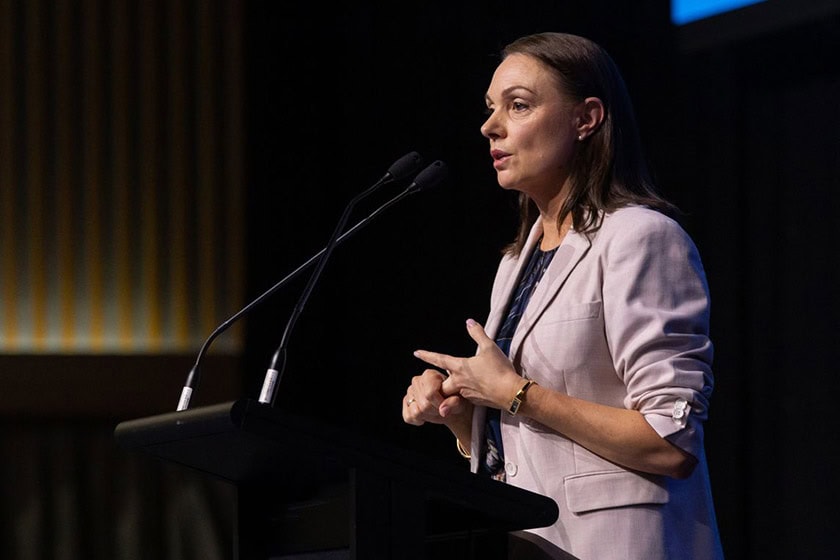
Business Council chief executive Jennifer Westacott said in its current form, the multi-employer bargaining legislation unveiled on Monday (31 October) won’t solve Australia’s wages problem and risks tipping our economy over the edge.
Ms Westacott said although the council welcomes the need for substantial amendments to the current legislation, the multi-employer bargaining is not a plan to do it.
“It’s good news that the government has committed to amendments to protect the primacy of single enterprise bargaining; provide for democratic bargaining processes in each workplace; and prevent anti-competitive conduct between competing businesses,” she said.
She said that amendments must be included such as changes to fix better off overall test.
“The key to getting wages moving is to revive the single enterprise bargaining system,” she said.
“We are deeply concerned that the new system could see small businesses swept up in a complex system dominated by unions and lawyers, currently one large workplace could vote to pull smaller workplaces into an agreement.”
The Australian Retailers Association (ARA) has called for more consultation and scrutiny of the Secure Jobs, Better Pay Bill to ensure it succeeds in achieving its objectives for employees and employers and builds on the goodwill established between employer groups and unions during the recent Jobs and Skills Summit.
ARA CEO Paul Zahra said some aspects of the government’s reforms will benefit employers and employees alike, but more time is needed to understand the proposed changes and their impacts on business.
“While we support changes announced about the Better-Off Overall Test and gender-based pay equity, the reforms that extend access to multi-employer bargaining are a real concern for our members,” he said.
“For our smaller members, many of whom are still recovering from two years of disruption, they don’t have the resources to work through a costly and time-consuming bargaining process with other employers and multiple employee representatives.”
The Council of Small Business Organisations Australia said its ultimate advocacy focus on behalf of all members is to help achieve an industrial relations system that is simpler and more accessible for small businesses to embrace and utilise to grow their businesses, employ more people and secure their sustainability for the future.
In a statement, COSBOA said there is a need to modernise, simplify, and ensure the Industrial Relations and Award system is fit for purpose for our modern workplaces.
It continued that the principles it seeks to see in our IR system are a need for more flexibility, not more complexity and ways to make it easier and provide more practical support for small businesses to engage in flexible and appropriate workplaces so they can ultimately employ more people. Which is good for business and good for the economy.
“We are continuing to work with government for a simplification of the BOOT and are looking to understand the practical application for this,” the statement said.
Australian Chamber of Commerce and Industry CEO Andrew McKellar said the amendments suggested by the government will increase strikes, create more complexity, and lead to higher unemployment, amid an increasingly challenging international economic outlook.
“This bill abandons enterprise bargaining, the key driver of productivity-based wages growth, in favour of compulsory multi-employer bargaining, reversing decades of tripartite consensus,” Mr McKellar said.
“The chamber welcomes changes to the ‘Better-Off Overall Test’, which will ensure that the BOOT is applied by the Fair Work Commission as it was initially intended — flexibly and as a global assessment, but remains concerned about the impact of substantial changes to multi-employer bargaining.
“If enacted, this legislation would drag multiple employers to bargain against their wishes. Businesses will be forced to adopt one-size-fits-all terms and conditions, which may be unaffordable and ill-suited to the needs of their workplaces. This is not opt-in.”
Innes Willox, CEO of the national employer association Ai Group, said the proposed changes risk taking the country down a path of more strikes, fewer jobs, centralised decision-making and less trust within our enterprises.
“The legislation is fundamentally flawed and needs to be rethought and reworked. Given its implications for our economy, employers and workers, this process cannot be rushed or be the subject of political trade-offs,” he said.
Mr Willox said for employers, the fundamental concerns with the bill include:
1. Changes designed to enable widespread strikes and other industrial action in support of multi-employer agreements.
2. The proposed expansion of multi-employer bargaining beyond what could reasonably be justified and absent sufficient safeguards to ensure that it won’t impact sectors or employers that are already capable of bargaining at the enterprise level.
3. The proposed expanded capacity for the Fair Work Commission to arbitrate the content of workplace agreements that will only encourage unions to make unreasonable demands and risks, taking us back to a system of centralised setting of wages and conditions.
4. Changes to existing employee rights to request flexible working arrangements that would expose employers to litigation over rostering and working arrangements that should otherwise be resolved at the workplace level.
5. Changes to the BOOT (better off overall test) and agreement-making process that may be intended to improve the system but risk creating new problems.
6. A range of problems with the practical workability and fairness of aspects of the bill that need to be worked through in detail.