Business confidence is now below the long-term average of 113.7 but remains significantly higher than the latest ANZ-Roy Morgan Consumer Confidence of 93.4 for 28 March to 3 April 2022.
However, despite the drop-off, more than half of the businesses surveyed said they remained confident that things will improve.
According to the index, business confidence decreased by 13.8pts (-12.9 per cent) to 106.7 taking a steep dive with the spike in oil prices that caused an immediate impact on the petrol bowser with Australian retail prices jumping to over $2 per litre for the first time in history.
There were falls across the index, but businesses are still broadly positive about the future with a majority (50.5 per cent) of businesses expecting “good times” for the Australian economy over the next year while almost half (46.7 per cent) said the next 12 months will be a “good time to invest in growing the business”.
On a state-based level there were monthly decreases across the board with the largest declines in the reopened Western Australia, down 28.6pts (-21.9 per cent) to 101.8, Victoria, down 16.9pts (-13.4 per cent) to 108.8, South Australia, down 13.7pts (-11.2 per cent) to 108.8 and Queensland, down 10.8pts (-9.9 per cent) to 98.7.
Rising petrol prices have also fed into increasing inflation expectations throughout the economy that has in turn increased speculation about when the Reserve Bank will raise interest rates for the first time in over a decade.
These pressures have led to a fall in business confidence that is now lower in all states except Victoria than this time a year ago. Confidence was highest in NSW but this was down a significant 23.9pts (-17.4 per cent) on a year ago as the state was beset by wild weather and devastating floods.
Victoria was the lone state to have higher business confidence than a year ago, up 0.9pts (+0.9 per cent) to 108.8. One year ago, Victoria had just experienced an unprecedented third statewide lockdown and businesses were understandably nervous about further lockdowns to come – which subsequently proved to be the case throughout the remainder of 2021.
Business confidence is below average in the three other states with the biggest year-over-year fall in Western Australia that opened up to the rest of Australia in early March and subsequently suffered its first big wave of COVID-19 during the entire pandemic. Business confidence plunged by 45.5pts (-30.9 per cent) from a year ago to be just narrowly in positive territory at 101.8 in March.
Property and business services was the most confident industry in February-March 2022 at a high of 129.6, an increase of 1.3pts (+1 per cent) on a year ago. Also performing well were finance and insurance with 128.7, a large increase of 12.7pts (+11 per cent) on a year ago, transport, postal and warehousing (126.2) and accommodation and food services on 123.3.
However, businesses have become far less confident about the longer-term outlook for the Australian economy with 44.7 per cent (down 7.8ppts) expecting “good times” for the Australian economy over the next five years compared to a rising plurality of 48.1 per cent (up 7.6ppts) that expect “bad times”.
Businesses are fairly evenly split on whether now is a “good time to invest in growing the business” with a small plurality of 46.7 per cent (down 6.4ppts), saying the next 12 months is a “good time to invest”, while nearly as many, 43.4 per cent (up 6.6ppts) said it will be a “bad time to invest”.
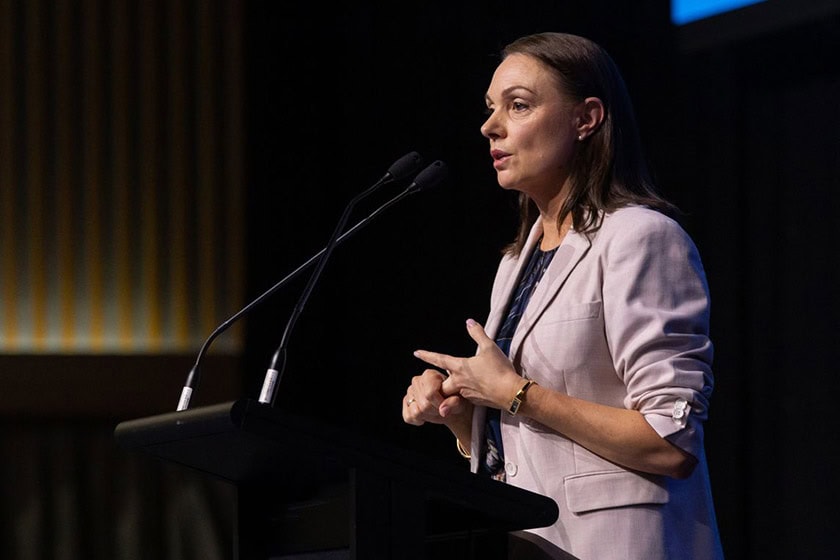
Michele Levine, chief executive of Roy Morgan, said a number of influences have impacted business confidence during the last six months including the reopening of NSW, Victoria and the ACT in October, followed by a highly disruptive wave of the “Omicron variant” during the summer months as well as extensive flooding in NSW and Queensland in March.
“The big global event during March has been the Russian invasion of Ukraine which prompted waves of sanctions on the Russian economy, including from Australia, and led to a global surge in key energy prices such as for coal, oil and gas,” she said.
“The most direct impact on the Australian economy has been the escalating price of petrol which was at an average of 158.4 cents per litre in the final week of 2021 and increased by a massive 54.1¢ (+34.2 per cent) by the middle of March – a huge impost on all Australians.
“The impact of higher inflation will be felt by all Australians over the rest of this year and is set to lead to interest rate increases later this year – perhaps as early as June, straight after next month’s Federal Election. The handling of an inflationary environment most Australians have never experienced is set to provide the first big test for whichever party is elected in May.”