
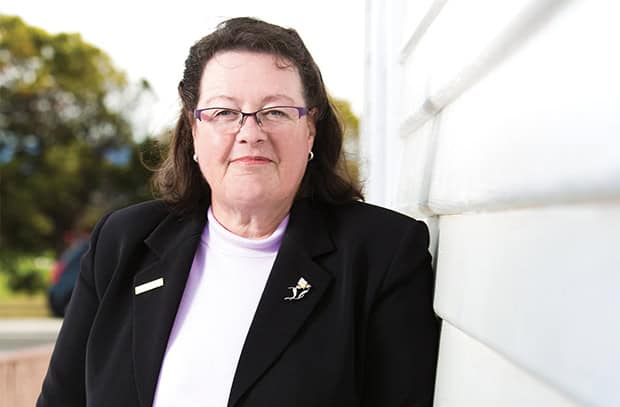
As a teenager in Tasmania, her first chosen career was that ultimate caring profession, nursing. But Jones soon realised her nursing studies were taking her in the wrong career direction. Bored and “keen to find something that suited me better”, she signed up for a bookkeeping course via correspondence. It was a life-changing decision.
She took to the structure of accounting like a duck to water. “I loved the balancing of debits and credits,” she says. “I love the sense of order and to be able to make things tidy and neat – which is strange, because I’m a messy person, really.”
Once qualified, she moved to Melbourne and landed a job with National Mutual Life Association, working on accounts for their agricultural stations. Then in her late 20s, she began challenging herself with a series of tougher qualifications: first a Bachelor of Management and then a Master of Accountancy through Charles Sturt University. She topped that off with a further advanced program completed in 2003.
Even for someone in love with balance sheets, this sort of advanced training was a test of endurance. She found some of the exams “gruelling” and recalls that “I kept saying at the time ‘this just doesn’t mirror real life’.”
Looking back, she acknowledges that her training “actually ended up being incredibly valuable to me”.
Working in Melbourne and Canberra, Jones took on increasingly complex accounting roles. Her stint in the public sector took her to the Department of Immigration and then to the Department of Industry, Tourism and Resources as acting CFO for the Professional Services Review. (The Review promotes integrity in the Medicare system by examining ‘inappropriate practice’ by medical practitioners.)
But home was calling. Jones returned to Tasmania to take up a job with the TOTE Tasmania wagering oversight body. She also bought a house in Hobart, marking her decision to stay put.
In July 2005, Jones founded her own company, CTC Taxation and Accounting Services, and began working as a public accountant. She learned the ropes of public practice from an experienced tax agent. Opening her own office in a suburb of Hobart in early 2007, she boosted her client list from around 350 up to nearly 1,200 clients by purchasing a sizeable portion of her retiring mentor’s tax business.
Jones works 12 hours a day because she says she loves what she does and feels privileged to be able to choose the people she works both with and for.
“I love accounting … it’s the greatest job in the world,” she says. “It’s fantastic when a client approaches me and wants me to show them how to better use their MYOB program, for example. It is just so satisfying to sit with a client’s spreadsheet of inventory received and used and determine quickly the quantity on hand. Those interactions are really satisfying.”
With a father who was a farmer and a mother a teacher, Jones suspects that her passion for the ordered nature of accounting might stem back to an earlier generation. “My grandfather died when I was a toddler and he was an engineer,” she says. “To be an engineer, you have to have a similar love of order to an accountant, so perhaps it was his genetic influence.”
Along with an in-depth knowledge of her clients and their businesses, Jones finds that the many skills she learned in her previous accounting roles – such as preparing submissions and managing databases – are helping to ensure the best accounting and tax outcomes for
her clients.
A delegate to the ATO’s Tasmanian Regional Tax Practitioner Working Group, she is also a keen attendee at the IPA’s CPD courses, especially the ones with emphasis on the problems faced by sole practitioners. Jones has attended every Tasmanian IPA Congress since 2007 and wholeheartedly endorses the opportunities they provide.
“The opportunities include meeting regulators and senior officials from relevant arms of government, which keeps you well connected,” she says.
And while she may have spent many years in a classroom learning accounting, she has also learned a number of other lessons on the job.
“You’ve got to draw on social skills to elicit data from clients to achieve the best legal result and carefully sidestep discussions that could be construed as financial planning advice,” she says. “You also have to read a client’s body language to see if instructions have been understood.
“But none of these are taught in a classroom. You just have to learn as you go along.”















