
Big business has been working on it since the late 1980s, because they know the value of it to their bottom line. Today, smaller companies can and should be looking at how to get a handle on their data.
I am about to tell you why this is becoming important to accountants – but first some explanations, as this is new ground for many of us.
The Gartner IT consultancy describes BI thus: “an umbrella term that includes the applications, infrastructure and tools, and best practices that enable access to and analysis of information to improve and optimise decisions and performance.”
BI lets us look at our business metrics to avoid making mistakes and to recognise opportunities for business improvement.
This applies to all businesses and is important to an organisation of any size. The larger the company, the more important it is to create systems to monitor, measure and report on the key performance indicators of the business.
So, what do accountants typically measure that could be termed business intelligence?
- Cash flow
- Profit
- Inventory
- Stock turns
- Billable hours
- Cash on hand
- Liabilities
- Gross margin
But to track the health of a business, it is often necessary to track other operational and risk factors of the business and hold managers accountable to delivering and improving on them. For example:
- Key industry metrics
- Benchmarking across multiple stores or offices for performance
- Customer satisfaction ratings
- Quality ratings
- Process time taken per process or per location
- Instances handled per employee
- Number of clients serviced by location
The list of possible combinations and permutations is infinite and very much determined by the business and its function. It could, for instance, be tracking the dollar value of stock in transit for an import/export company, which serves no purpose at all for a services company.
Let’s not get too stuck on what to measure but simply acknowledge there is plenty to measure in any company that is looking to improve margins or productivity.
It is the relationships between the key operational measures and their impact on cash flow, profitability and so on that can make the difference between business success and failure.
It is not enough to measure profit – that’s like looking in a rear-view mirror to drive to Perth. Visualisation can help people draw out relationships, and interactive dashboards can support ‘what if?’ scenarios that show what happens to profitability and so on when other levers in the business are pulled.
The IT world is well known for making things for enterprise and then developing smaller, faster and cheaper ways of delivering it to smaller businesses at a sensible cost. This is now beginning to happen in the BI world, too.
No doubt you have heard about the new wave of charts and graphs available through modern accounting tools such as Xero, Saasu, SAP Business One and MYOB EXO Business, among others. These are a form of BI for financial information. Salesforce.com is a CRM tool known for its great reports for marketing, sales and account management.
These analytic display tools are now being defined as ‘data visualisation tools’. Where tools that provide traditional BI solutions to larger businesses cost many tens – or even hundreds – of thousands of dollars and are out of reach to the SME sector, there are now pure data visualisation tools that can quickly turn static reports into dynamic dashboards.
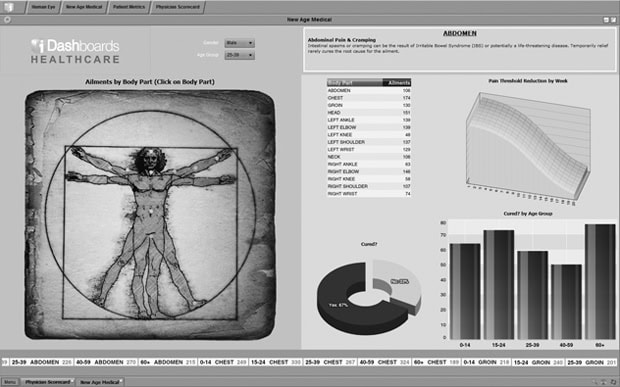
One such product is iDashboards, which offers affordable access to SQL, Oracle, Access and Excel based data sets.
Such tools provide charts, maps and flash animation to create graphically stunning representation of complex data sets. With a couple of days training, internal staff with knowledge of data management can have graphs and charts up and running to show what is happening in the business.
Dashboards create interactive visualisations, not just static charts. This draws people into the data. Executive-level staff can actively interpret data, leading to better decisions. Dashboards are easy to use, interactive and provide great visuals and cutting-edge infographics. This lets you and your clients or employers be the industry leader by seeing trends sooner.
What iDashboards and similar tools won’t do is create structured data from a messy database. They won’t show a consistent pattern for inconsistent data entry methods. They also will not help you to make the right decision if the underlying formulas producing the data are wrong.
While the pretty output will make people want to play with the data and learn more, having the tool will not necessarily inspire people to do the work required to build the right dashboards. As with any new tool, a deployment and testing plan will be required. A process of training and storyboarding should be used to ensure the activity is completed and the tools are put to good use.
In a world where we are bombarded with data, dashboards translate it so that the right people in the organisation can pick up on changes in conditions faster and take appropriate action sooner.















