
At a glance
- A new AI-driven ledger promises to automate bookkeeping with very high accuracy.
- Its unique data model gives it context and classification accuracy.
- The system automatically reconciles 95% of transactions, flagging outliers for human review.
The dream of a self-reconciling ledger seems finally within reach. Cloud accounting software has promised automation for years – but it still relies on people to approve and reconcile transactions. Now Digits, a San Francisco start-up led by former Twitter product head Jeff Seibert, says it is on the verge of removing the human failsafe.
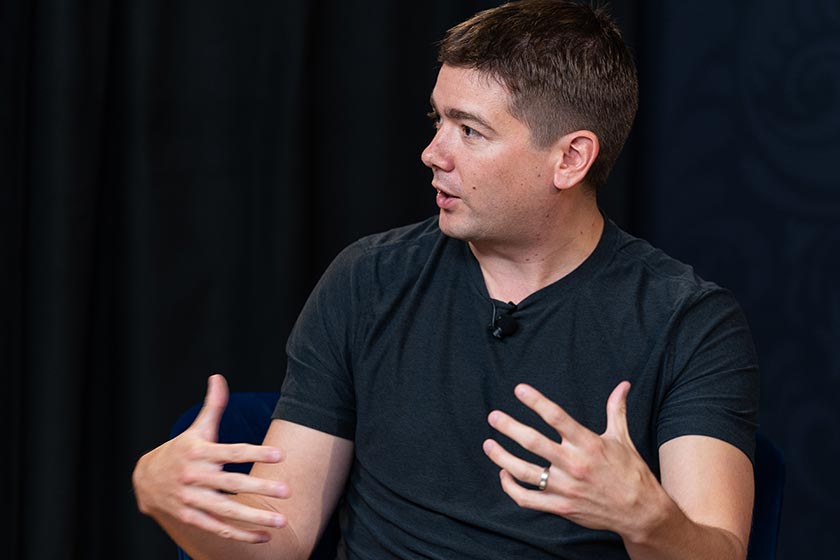
“What we mean by autonomous is that Digits understands the month-end close process, the accounting workflow, and it is working 24/7,” says Seibert (pictured above). “Every time a transaction comes in from your bank, it gets booked to the ledger.”
That statement may not sound particularly radical. Auto-categorisation has been a feature of cloud accounting software for over a decade. Even some banks categorise your transactions to a custom set of accounts right in the online banking interface.
But Digits has an architecture which it argues is fundamentally different to that of the incumbent platforms. That, says the company, means it can categorise transactions with far higher levels of accuracy.
So the company bills its software as “The World’s First Autonomous General Ledger”.
Beyond the text
Traditional accounting platforms store every transaction as a line in a relational database – a decades-old architecture. When you tag an Uber ride as transport, Xero or QuickBooks will apply that rule to every future Uber transaction. That may leave it unable to distinguish an Uber Eats delivery from a business Uber trip, Digits says.
Digits replaces this with a vector-graph data model, where every vendor, customer, invoice and account is an interconnected object. This gives its AI a “semantic map” of your financial network – the same type of graph technology Facebook uses to suggest friends. And that lets it recognise that when someone tags an expense as “Uber”, it doesn’t necessarily mean “Uber Eats”.
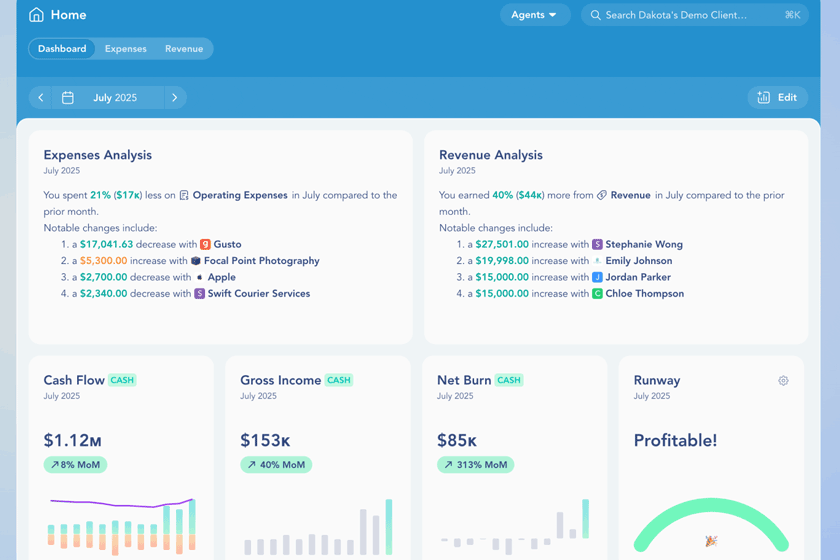
With mid-90 percent confidence in its classifications, Digits says it can comfortably bypass manual “OK” approvals altogether. Instead of waiting for human confirmation, the system applies its classifications automatically and posts them directly to the ledger.
That’s what enables Digits’ claimed next level of automation, and delivers real-time reporting.
“As soon as the bank statements are available, we pull them from your bank and reconcile the account, and we do the flux analysis, the insight generation and reports for you,” Seibert says. “As an accountant, you’re just in the review mindset, maybe fixing up some little issues; you review the numbers, and you’re done. The books are closed.”
The trust question
The challenge with all such LLM-based systems is trust. If an AI engine algorithm books transactions incorrectly, it can quickly turn a neat set of accounts into a murky, illegible swamp.
Unlike the large language models (LLMs) that power ChatGPT, Digits uses non-LLM predictive models that can’t hallucinate. They also have confidence intervals, which show how confident they are in their predictions.
“LLMs plateau at around 70 percent accuracy … Outsourced human accountants hit about 80 percent. Our models are in the mid-90s.”
– Jeff Seibert, Digits CEO
“If the model is highly confident, great – we can trust it, and we put it right in the ledger. If the model is not confident, we throw it out, because the last thing you want is a mistake in your accounting,” Seibert says. “We just surface the transaction in your inbox, and you or your accountant can book it.”
Digits has been training its predictive models since it launched in 2018, well before the ChatGPT boom. But given the interest in LLMs, Digits conducted a study to see how well its predictive models performed against them.
“LLMs plateau at around 70 percent accuracy for transaction classification,” Seibert says. (Public Accountant has chronicled this problem.) “Outsourced human accountants hit about 80 percent. Our models are in the mid-90s. That’s because they’re trained on the specific context of each business.”
Just as we know we can’t make self-driving cars completely crash-proof, it may be impossible to get automated bookkeeping to 100 percent accuracy. But business owners and managing partners will likely settle for slightly less than perfect accuracy if it comes at a far cheaper cost – and if, like a good self-driving car, it creates less risk and more accuracy than people do.
Digits wrote up the results of its work in an early 2025 white paper which it has published on its website. While it wasn’t an independent study, it was still convincing enough for high-profile venture capitalists such as Google Ventures and Benchmark (among others) to invest a combined US$100 million at a valuation of US$565 million (A$860 million).
The ‘layer cake’ model
Digits says its accuracy in transaction categorisation springs from its architecture, which Seibert describes as a layer cake.
“Our top tier model trains on each individual business, and it gets really good at memorising and learning the financial activity of each client. The next tier of model we just launched last week is our firm model. This trains across the accounting firm’s client base. It learns the firm’s best practices.
“Then it falls back to our global model, which trains across our entire data set (of businesses). If our global model also hasn’t seen it – imagine you spent money at a brand new coffee shop that just opened down the street – and the transaction is totally novel, we do fall back to an LLM to do a zero-shot classification,” Seibert says.
So what does autonomy look like in practice? Digits automatically matches and approves transactions 24/7, showing only transactions that don’t meet its high confidence threshold.
While the ledger isn’t yet fully independent, it’s remarkably close. On average, it automatically reconciles 95 percent of transactions; it holds the remaining five percent for review.
Seibert says that in edge cases, the model looks for cues from credit card usage, merchant names, even spend amounts. For example, Digits is smart enough to know that a $2,000 Apple charge is most likely an equipment expense and a $20 Apple charge is a subscription.
When a company spends on one Uber trip for a sales meeting and another for delivery, which would impact COGS, Seibert recommends using different credit cards. Digits then learns how to categorise the vendor’s transactions to the correct account by identifying the card used to pay for them.
Another way of creating trust is Digits’ internal audit process, where it checks transactions provided via bank feeds against bank statements.
“We reconcile each transaction down to the pixel on your PDF bank statement,” Seibert says. “You click the transaction, you see it highlighted on the page. It saves a huge amount of time in audits.”
The incumbent dilemma
As noted earlier, Digits’ architecture gives it a structural advantage the incumbents can’t easily match. Intuit, Xero and NetSuite all made similar decisions when they rebuilt their ledgers for the cloud more than a decade ago, choosing relational databases.
That design now limits how far they can push automation. Each transaction sits as a line of text, disconnected from the context around it. Some products can’t recognise a company as both a customer and a supplier.
Digits’ vector-graph model links every vendor, invoice and account in a connected web. This network gives its AI the context to understand financial flows instead of just tagging text strings, the foundation for its higher accuracy.
Rebuilding those old ledgers isn’t impossible, but it would take a major investment in time and money. “They screwed it up when they built the cloud,” Seibert says. “It’s a mistake at the architecture level, and even with billions of dollars, it’s a multi-year rewrite to change the system.”
That’s why the incumbents are layering AI assistants and chatbots on top of their existing systems, rather than replacing the engine underneath.
The next step forward
However, a full rebuild may not be the only path forward. Some researchers believe the next generation of AI agents could bypass these architectural limits altogether – using today’s accounting systems as tools rather than rewriting them.
Professor Marek Kowalkiewicz, chair in digital economy at Queensland University of Technology, says the next step won’t be larger language models but “large action models” – systems where an LLM orchestrates specialised tools to perform precise, deterministic tasks.
In this setup, the model could act like an accountant: entering data, validating categorisations and reviewing reports directly inside the software. It might call an OCR tool to read a receipt, post to the ledger, then draft a summary. Humans would review the LLM’s work much as a senior accountant reviews that of a junior.
Some software vendors are already teaching LLMs to hand off number work to external tools via emerging standards such as the Model Context Protocol. In this version of the future, Xero and Intuit’s relational databases become a minor handicap – something a super-smart LLM can navigate at lightning speed.
So why haven’t Intuit and Xero done the same already? Both companies have similar goals of automating accounting. However, they both made similar mistakes when they built the databases that underpinned their cloud accounting software in 2011.
“If you look at QuickBooks, Xero, even NetSuite, SAP, etc, they’re all relational databases. This is 20- to 30-year-old technology. Every transaction is a row in their database, and they just see text. So when you have an Uber transaction, they don’t know what Uber is,” Seibert says.
This architecture not only requires manual reconciliation, it also leads to frustrations such as QuickBooks’ inability to identify a company as a customer and a supplier. (The current workaround is to create two companies with the suffixes “-customer” and “-supplier”.)
“We use a vector graph data model where everything is an object – your vendors, your customers, your bills, your invoices, your chart of accounts. That allows the models to have this semantic understanding of the financial flow. Our models know Uber and Uber Eats are different. They know that Lyft is clustered closer to Uber. It’s that type of knowledge that allows the bookkeeping to get really good.”
So what does this mean for the incumbents? Will they just rebuild? Seibert isn’t worried, at least in the short term.
“They screwed it up when they built the cloud. Yeah, they have billions of dollars, but the challenge is when you make that mistake at the database architecture level, it’s a multi-year rewrite to change the system,” Seibert says. And what does this level of automation mean for accountants? Seibert says that automation can’t come fast enough – because the profession is facing an unprecedented, worsening talent crisis.
Seventy-five percent of existing US CPAs are nearing retirement age, and yet US CPA enrolments are down 33 percent, Seibert says. “Gen Z doesn’t want to be an accountant. They see it as tedious bookkeeping.”
Seibert says Digits aims to change that. “Our firms are replacing outsourced teams with Digits. Their US-based staff can focus on advisory. That’s more compelling for new grads.”
The product has only been in market in the US since March 2025 but is already working with “hundreds of firms” and “thousands of clients”, he says. He promises more features to come, including schedules – prepaid, fixed asset, depreciation.
“Digits knows when you bought a computer and how much it cost. It’ll soon book the asset and generate the schedule. That’s where we’re heading,” Seibert says.
“We’re bringing those schedules natively into the ledger, because if the AI sees the schedule and understands the depreciation, it can just manage that for you, and you don’t have to check that every month.”
Whether Digits can achieve the dream of full autonomy is still an open question. But it’s already booking, reconciling and reporting faster than most humans, it allegedly makes fewer mistakes, and it’s never going to charge for overtime. For many business owners and accountants, that’s a powerful pitch.
Explore a mix of expert-led sessions, hands-on workshops and meaningful networking opportunities at IPA’s National Conference 2025 which has been designed to inspire, challenge, and energise you. Register now.












