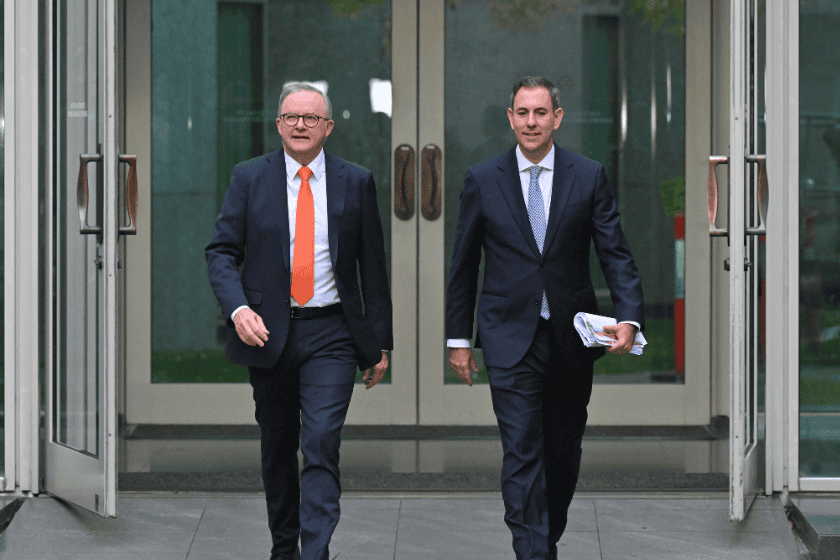
Image: AAP Image/Mick Tsikas
Small businesses contribute $483 billion to the economy, equating to 33 per cent of Australia’s GDP and employing more than five million people or 42 per cent of the private workforce. Yet they face mounting compliance obligations, a complex tax system and challenging operation conditions amid geopolitical and trade uncertainty.
Australian Small Business and Family Enterprise Ombudsman (ASBFEO) Bruce Billson told Public Accountant that small businesses remained overlooked in national economic discussions despite their vital economic contribution.
“Small businesses can’t wait for years and years for supportive action at this time of significant economic and cost of doing business challenges,” Billson says. “We need to redouble our efforts to nurture and develop the small and family business economy and turn around some worrying trajectories.”
Billson says the current operating climate is economically unsustainable for the small business sector. “Nearly half of our small businesses are operating at a loss, and the majority of self-employed business owners earn less than the average full-time wage,” he says.
Treasurer Jim Chalmers post-election focus on productivity was welcomed. “It was pleasing to hear after the election, the Treasurer talking about productivity,” said Billson. “Small and family businesses are key to uplifting productivity for creating new services, new ways of creating wealth and opportunity.”
Right-sized regulation
Regulatory burden remains a significant barrier to small business productivity. Michael Davison, General Manager Advocacy and Emerging Policy at the Institute of Public Accountants (IPA), says complex and excessive regulations are stifling growth, hindering innovation and making it increasingly difficult for small businesses to remain competitive.
“This is unsustainable,” Davison says. “There is a focus on cost-of-living relief for households, but self-employed business owners continue to go backwards. Supporting small business is crucial to revitalise Australia’s productivity and grow our economy.”
Billson pointed to additional regulation in the hospitality sector as an example of disproportionate regulation. “There’s a proposal coming through now about reporting on country of origin labelling for seafood… the idea that you and I running a corner pizzeria need to change our menus if we get our anchovies from a particular country…to create a marketing advantage for locally based seafood by imposing a regulatory burden on a sector that’s already doing it extremely tough in hospitality with very thin margins,” he says.
Productivity policy
Industry bodies are pushing for a comprehensive approach to boost small business productivity, including:
- Tax reform: COSBOA (The Council of Small Business Organisations Australia) CEO Luke Achterstraat called for genuine tax reform and reducing the company tax rate for small business from 25% to 20%. This would make “good economic sense, potentially boosting Australia’s GDP by up to $11.4b over five years”.
- Asset write-off changes: There is an opportunity to make the Instant Asset Write Off permanent and increase the threshold above $20,000. Billson noted small businesses are seeking a “more generous and more durable” instant asset write-off, not a temporary measure that creates uncertainty.
- Digital incentives: Billson also advocated for the “restoration of the digital tax incentive, where small businesses were getting some tax advantages by investing in digital capability”. “Deepening digitisation within a business is really important right now, particularly on productivity and competitive terms,” he says.
- Small business impact assessments: Billson called for greater consideration of small businesses when new laws are made, suggesting “every Cabinet submission, preliminary, and formal regulatory impact statement and new policy proposal [should] include a small business impact statement.”
- Dedicated agency: The IPA has advocated for a body dedicated to small business, like the US Small Business Administration Agency, to provide a one-stop-shop for multiple services. This would include access to capital, mentoring, regulatory guidance, technology support, market expansion assistance and disaster recovery help.
“Nearly half of our small businesses are operating at a loss, and the majority of self-employed business owners earn less than the average full-time wage.”
Bruce Billson, Small Business and Family Enterprise Ombudsman
Small business forum
Achterstraat wants the Government to convene a small business forum that brings together politicians, peak bodies, small business operators and other key stakeholders to set the sector up for success. “It’s vital that the government makes small business a greater priority in this term of parliament,” he said.
This follows data that reveals conditions for small businesses deteriorated by 0.3 per cent according to ASBFEO, despite the post-COVID 19 operating environment stabilising.
“What can we do to improve the operating environment for those courageous and valued, enterprising men and women?” Billson says. He reiterated his fears that Australia needs to avoid “sleepwalking into a big corporate economy where we’re seeing a growth in the big end of town in terms of share of GDP and private sector workforce”.
More information on the IPA’s policy priorities for the 2025 federal election to lift Australia’s productivity here.
IPA CEO Andrew Conway has started a fundraiser for the Male Hug to run at least 24.19 km a week until October (Talktober) to raise awareness about the more than 2,419 men who die by suicide in Australia each year. Visit Andrew’s GoFundMe page here.