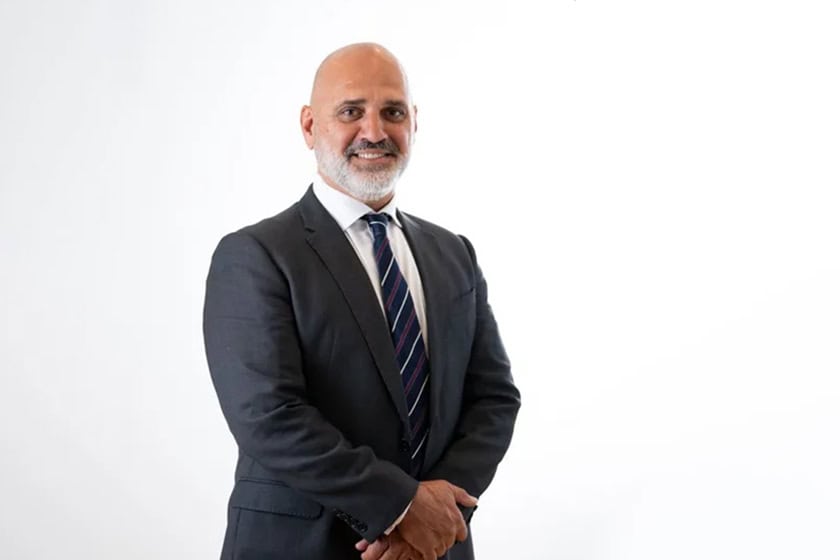
Q: You arrived in Australia as a young refugee. Can you tell us about those early years, and how they shaped the professional you have grown into?
My three siblings and I had a very blessed childhood until the Turkish military invasion of Cyprus, in the summer of 1974. I was almost 11 years old when my parents, siblings and I moved to England. We were put in a detention centre, but my parents sent my two eldest siblings overseas for two years so they weren’t living in refugee camps. That was very disruptive.
We lived in Athens for a year and then came to Australia when I was 12 years old. My parents lost everything they’d worked for, but they were still very sensitive to our needs as kids, so despite the trauma, it was still a beautiful upbringing.
I arrived in Australia as a teenager with my family. I was the youngest of four children and our beginnings here were very humble. Like most migrants, my parents worked 16-hour days almost every day of the year. They instilled in me the value of hard work. Hard work comes first, smart work comes second and then wealth follows.
Q: Your parents’ values and role modelling are incredibly relevant to a career in financial planning. But they couldn’t have had a crystal ball – why did you build a finance career?
When I was 28 I met a financial planner, Jamie, who suggested I consider financial planning as a career path. He invited me to his office to observe how the business operated. He opened my eyes to finance. I spent about three years working with him. The crux of what we did was selling saving plans. The market was very different back then and financial planning has changed dramatically since, but it was a good introduction to what financial advice looked like.
After that, I bought and sold various businesses and held corporate executive roles. In 2000 I was tapped on the shoulder to join Westpac. Working there was a good experience but I quickly realised it wasn’t where I wanted to be long-term. I provided advice on a strategic level and sent clients to lawyers or mortgage brokers, but when they came back to see me two months later, I often found there had been little progress.
Most of our clients were business owners, CEOs or CFOs, juggling work and family commitments. Once they had left my office, unless they had someone assisting them in their timeline and keeping them accountable, they’d rarely follow through.
I saw an opportunity to assist people and help get them on the right path. I started my business so I could work alongside them, and keep them accountable to their goals. That’s why I took the punt to start my own business. It was hard to get the business going, keep the cash flow and support my family. I was 41 years old, had a mortgage and two kids, but it’s one of the best decisions I’ve ever made. We very quickly morphed into where we are today, with a private wealth model supporting clients all the way through their financial journeys.
Q: You’ve just described your path through the hard work and the smart work – that lesson has clearly guided you well. Are there other key lessons you’ve learnt since, as a financial strategist working closely with accountants?
Don’t underestimate the importance of active listening. In professional services you have to be an active listener otherwise you miss half the necessary information.
I expose my employees, including university students, to all parts of the business from day one. They’ll sit with me in meetings and I’ll often ask them to put together file notes that we’re obligated to complete as professionals. I might provide the context to guide the file notes but it’s largely them doing the writing. I’ll look at the file notes and see if they’ve been actively listening or just hearing. This is such a critical skill to cultivate early on.
The other reason I get my employees involved in every aspect of the business from the get-go is because I’ve learnt there is no substitute for practical experience. I would’ve been in a better position to serve my clients if I’d spent a year within Westpac’s private wealth arm. That would’ve enabled me to better extrapolate parts of that model in my own practice. Even though I was committed to what I was doing, it took me a few years to find my feet. You can’t overstate the value of practical, hands-on experience. I now try to pass lessons like these onto the next generation of financial planners. Mentoring is not academic, it’s based on practical experience.
Q: Your practical experience now includes having represented the IPA in roundtable discussions with Federal Government agencies including DFAT, Austrade and others, as well as being part of IPA delegations to London and China. How does that experience shape your practice?
I’ve always been nurtured to think about issues from a global perspective, and I’ve been on some fantastic overseas trips.
The China Delegation with IPA in 2016 was focused on the China-Australia Free Trade Agreement signed in December 2015. We went to Beijing to understand what the Chinese and Australian accounting industries were learning from one another, and how IPA could help to build bridges between the two countries.
The phrase, ‘Think globally, act locally’, applies to almost everything I do. I have clients all around the world: in Germany, many countries in Asia and in Australia. While they may not be in Australia, they still have unique financial needs that I cater to through various investment strategies.
I consider all clients to be global citizens. A client might be working in Sydney today, but they could be working overseas tomorrow. I often think about how that might play out and how I can help them to prepare financially. I work with them to understand their goals, what makes them tick, and how I can get them in the best financial position possible.