
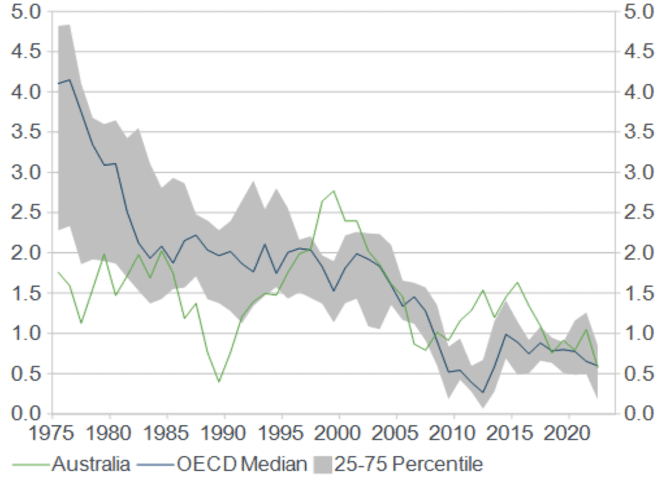
Productivity growth – doing more with less – has made the rich nations rich and modern incomes the highest in history. But in the past quarter-century, it has slowed sharply in most advanced nations, Australia very much included. Inevitably, Australians’ income growth has slowed with it. Since COVID, more people have found themselves earning less, after inflation, for the same work.
Advanced nations’ long productivity growth decline
Productivity growth in Australia and the OECD, percentage annual change 1975-2023, with milestones
Dynamic and skilled
With inflation back inside its desired range, federal Treasurer Jim Chalmers wants Labor’s second term of economic management to be about “primarily productivity”. He hopes five new reports he has commissioned from the Productivity Commission will give the Albanese government a productivity agenda for the rest of this decade. Those five reports cover:
- Creating a more dynamic, competitive and resilient economy;
- Building a skilled and adaptable workforce;
- Harnessing data and the digital economy;
- Investing in the net zero transformation; and
- Delivering quality care more efficiently.
Government economists have understood productivity’s importance for many decades, but they have no single agreed solution to the current slump. A 2023 Productivity Commission report recommended 71 reforms, most of them already oft suggested.
Discussion of productivity often focuses on large businesses – that is, those with 200 or more employees.

But Australian Bureau of Statistics figures show small and medium enterprises (SMEs) with less than 200 employees produce the bulk of Australia’s industry value-added. In 2023, SMEs produced 56 per cent of total Australian value-added, worth around $1 trillion of the nation’s $1.8 trillion total.
So, as we enter the second quarter of the 21st century, what are the federal government’s best bets for driving SME productivity growth?
Prioritise diffusion of ideas over invention
The federal Productivity Commission has for some time emphasised innovation’s potential to fuel productivity growth. But it urges government to prioritise the spread of already-existing innovation. Productivity Commission deputy chair Alex Robson points to a statistic in the Commission’s 2023 report Innovation for the 98% : most Australian SMEs raise their productivity not by new-to-the-world innovation but by adopting useful innovations devised overseas. This process of diffusion seems especially important for SMEs, the Commission found.
The Institute of Public Accountants (IPA) has backed this idea, arguing that “diffusion has the potential to lift the performance of over a million businesses”.
The most important implications of promoting diffusion are that governments should:
- Help SMEs to adopt existing best-practice technologies and techniques from around the world;
- Encourage workers to move between jobs to speed up the spread of new ideas; and
- Invest in education and training systems that build transferable skills.

Professor Rui Torres De Oliveira, director of the IPA-Deakin SME Centre, also criticises the role of universities and the CSIRO in disseminating new ideas to businesses.
Reduce the regulatory burden
Michael Davison is the IPA’s general manager, advocacy and emerging policy, and he points out a problem standing in the way of more SME innovation. Despite episodes of deregulation in sectors like finance, most SMEs contend with a continuing increase in regulation.

Often targeted at big business, such regulation can end up robbing SMEs of time for the new techniques that could raise their productivity. “There’s very few that have the headspace to go: ‘How am I going to grow my business? What’s next? How do I take advantage of these tools?’,” he says.
The IPA-Deakin SME Centre’s Professor De Oliveira argues the desire for more complex regulations has now created a risk-averse culture in Australian business. He has been recounting a simple message to regulators such as federal Treasury: “Please don’t complicate”.
Michael Davison has been continuing the IPA’s advocacy for “right-sized regulation”, so that new and existing rules consider SMEs and do not disproportionately impact them.
Davison and the IPA would also like the federal government to establish “a one-stop shop where you can go to get access to the various government departments”. This one-stop shop would also help SMEs to access loans and grants; help generate investments in innovation and help SMEs with compliance requirements.
“The fall in investment in Australia’s share of GDP is concerning. That’s one of the reasons why we’re looking at corporate tax in Australia in this dynamism and resilience inquiry.”
Alex Robson, deputy chair, Productivity Commission
Foster business investment
The Productivity Commission has for many years pointed to a fall both in the dollar value of Australian investment and also in “business dynamism”, the process whereby firms change and expand.
“The fall in investment in Australia’s share of GDP is concerning,” says Robson. “That’s one of the reasons why we’re looking at corporate tax in Australia in this dynamism and resilience inquiry … There’s many things that could affect investment, but that’s a key policy.”
Reversing this trend is likely to require new policies that encourage SMEs to invest in capital, technology, and workforce development.
* David Walker runs report-editing consultancy Shorewalker DMS. He edited CEDA’s “Competing from Australia” report on trade and competitiveness and the federal innovation policy report “Venturous Australia”.
More information on IPA’s small business advocacy here.