“My mum came from the land,” he says, “and my dad ran a menswear store. Two of my brothers still run it. I still have that shopkeeper’s mentality – put more money in the till than you take out. A lot of those discussions around the table have stayed with me.”
Mentha left Cobram to board at Melbourne’s Xavier College as a senior student. A photograph on a wall of Xavier’s Stephenson sporting complex features him as one of the
stars of the 1977 athletics squad.
“I was a very good runner at that level,” he recalls, adding that he was coached by distance running doyen Pat Clohessy.
Today, Mentha still runs and walks in the Kew neighbourhood – although these days, he says, his running style is “a bit more like the Cliffy Young shuffle from here to Sydney”.
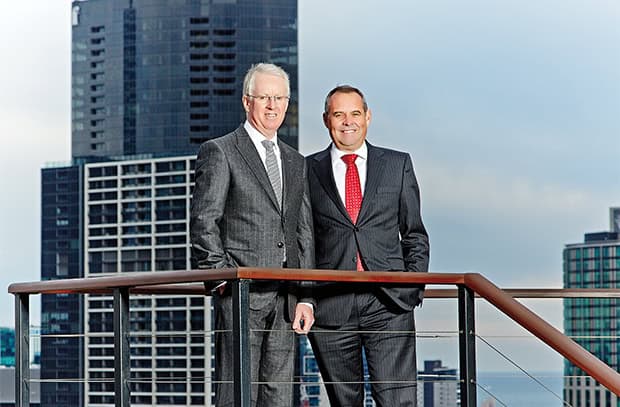
His professional partner, Mark Korda, smiles. Korda’s father fled Czechoslovakia in 1946, working on the Snowy Mountains Scheme with other migrants before settling in Melbourne.
“My mother came from Brunswick and we shifted out to Nunawading,” he says. “It was a lot different then to what it is now.
“Once all the kids were a bit older, mum went back to work full-time.”
Korda attended Whitefriars Catholic College in Donvale, and one of his passions is the Collingwood Football Club, where he’s a board member.
Both men say their work ethic and the way they approach their insolvency work is influenced by their upbringing.
The pair began working at now-defunct accounting firm Arthur Andersen in the late 1970s, progressing through the divisions before settling in restructuring. But it was the post-9/11 Ansett collapse, and their subsequent appointment as administrators, that transformed them into accounting superstars.
In May 2002, they left Andersen – taking the Ansett business with them – put up the KordaMentha shingle and began steadily building a business that now employs 400 and takes in insolvency, forensics, property, consulting and management.
Ansett – and the high-profile fate of its 15,000 workers, $3.5 billion in assets, 42 associated businesses and 10 million spare aircraft parts – became their calling card.
“Whenever Mark and I are at an airport, we are still stopped by ex-Ansett employees who go out of their way and say ‘how lovely to meet you and thank you for what you did for us’,” says Mentha.
While Solomon Lew’s and Lindsay Fox’s Tesna deal to buy Ansett fell over at the last hurdle, there were some victories. Ansett employees, for instance, received 96 cents in the dollar of their entitlements.
Korda and Mentha say they are proud that the entitlement, enshrined in the Special Employee Entitlements Scheme for Ansett Group Employees (SEESA), has led to safeguards for redundant workers.
The partners have used their entrepreneurial skills to restructure several struggling high-profile businesses, including Timbercorp, Tassal and Greyhound Australia.
Korda says the effect on rural communities of the 2009 collapse of Timbercorp, with its plantations of olives and almonds, would have been profound. They were able to work with Boundary Bend olive company to salvage the olive harvest, saving jobs and securing the future of Cobram Estate olive oil.
“I still buy that olive oil and it is from my home town,” says Mentha, adding that his loyalty extends to the Cobram Tigers, who wear guernseys bearing the KordaMentha logo in the Murray Football League.
The collapse of Tassal’s Tasmanian salmon-farming operations in 2002 saw KordaMentha thinking bigger rather than smaller. They bought out another competitor and brought economies of scale to the operation.
When bus line Greyhound Australia faltered in 2006, they took it over, and Mentha is currently chairman of the operation, in which KordaMentha holds the majority stake.
“We knew from the work we had done with airlines that we could not compete with low-cost carriers,” says Mentha. Instead, they tapped into mining transport, stitching up lucrative contracts to transport miners to far-flung places.
Korda established the firm’s 333 Real Estate division, which he proudly says boasts 35 tertiary-qualified real estate employees. (The 333 comes from their office address in Melbourne’s Collins Street.) “We would get about 80 per cent of the real estate workouts,” he says.
Rather than let failed projects sit idle, they are completed with the aim of making them commercially viable. Current projects include Southport Central on the Gold Coast, Raine Square in Perth and Hopkins Correctional Centre (formerly Ararat Prison) in Victoria.
Having seen whole industries falter, Korda says one of the best things any government can do is to put money into helping companies and staff transition as the business world changes.
He agrees that there is plenty of doom and gloom about bricks-and-mortar retail, but they have worked hard with several retailers to try to meet the challenges. “We helped them get their rent and inventory right,” he says.
Korda is a staunch defender of the Australian insolvency system, saying it works better than the US Chapter 11 process (a form of bankruptcy that involves a reorganisation of a debtor’s business affairs and assets).
“There is a perception that it [Chapter 11] is better and cheaper, but it isn’t. Chapter 11 is court-supervised, very expensive and run by lawyers,” he says, adding that in Australia, many companies are restructuring behind the scenes, usually under new ownership and with an injection of cash.
Korda says that under the US system, there was no way the deal with Boundary Bend to take on the Timbercorp olive groves would have been done. The olive harvest would have perished as the court cases rolled on. “We were able to enter into agreements to allow olives to be harvested,” he says.
This ‘can do’ attitude and quiet assurance is reflected in an observation by one of their clients. “They would be great at playing poker because you can’t really tell what they are thinking,” he says, adding that he can’t speak highly enough of Korda’s resolve during their dealings. “It is such a stressful business. I don’t know how they do it, but they do.”
Korda sums up their ethos: “We have a [presentation] slide in the office and it talks to what sort of firm we want to be and our values.
“It includes that we treat everybody with empathy and that we must always remember we are dealing with other people’s money. It’s not ours.”