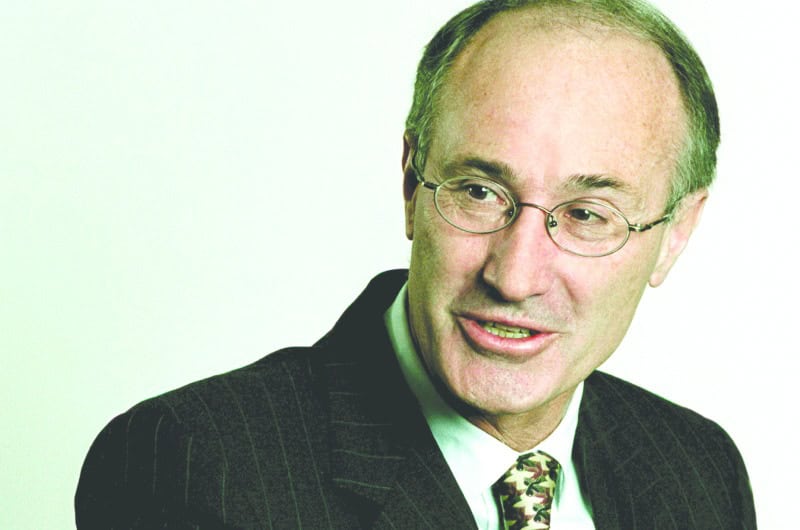
When Kerr Neilson left his job as a fund manager at BT in 1993 to open his own shop, Platinum Asset Management, he had one big advantage over the other hopefuls putting out their shingles in the emerging boutique investment management market. Investor George Soros, who only two years earlier had come to the attention of the financial world after being dubbed “the man who broke the Bank of England”, took a stake in Neilson’s business and provided seed money for his fund.
The business arrangement lasted 10 years, and during that time Neilson’s twice-a-year New York meetings with his mentor left their mark. “When you meet someone like him, you realise how good the very good are,” he says. “I used to drive my team mad because I would come back from New York full of new ideas about how we should be doing things.”
Neilson himself has long since been inducted into the ranks of the very good. Last year, he was included in Magnus Angenfelt’s book The World’s 99 Greatest Investors. In April this year, Forbes listed his net worth at AU$2.9 billion. Platinum has AU$22.8 billion worth of funds under management, and its flagship fund, the Platinum International Fund, has produced an average return of 13.1 per cent a year since it was launched. The MSCI World Index has grown by 5.5 per cent a year over the same period.
If Australia has a truly world-class investment mind, Neilson is it.
Founding principle: ignore the benchmarks
Two things distinguished Platinum in its early days: it was a global investor run out of Sydney, and its investment style was ‘benchmark unaware’ or “absolute return’, at a time when most managers measured their returns in terms of their relative performance against a share market index or some other benchmark. Neilson was also prepared to hold short positions in his portfolios at a time when that was not a common practice.
His style led to some misunderstandings. He got into fights with companies that did fund ratings and performance tables, some of which put the International Fund into the hedge fund category.
“It was not a hedge fund and, anyway, I didn’t want the market to see me as a Flash Harry,” says Neilson.
Platinum still applies those principles today. The managed investment industry has caught up with Neilson over the years, and there are plenty of absolute return and long/short funds in the market these days. However, Neilson argues that most managers still stick failry closely to a benchmark unaware.
“In 1900, UK stocks made up 25 per cent of the world’s equity while demand has been growing market capitalisation and US stocks made up 15 per cent,” he says. An investor who put 25 per cent of their money in the UK market would have watched it shrink to 8 per cent now, while the US market grew to 48 per cent of global market capitalisation.
“Now the question is whether 48 per cent of our wealth is going to come from the US in future. At Platinum, we don’t think so. Investment should always be about looking to the future, not the past.”
Investment style: foundations, not financials
What’s startling about Neilson is how sharply he deviates from the typical picture of the investment numbers man. Platinum’s website describes the firm as a stock-picker, conjuring up an image of someone diligently poring over balance sheets in search of unrecognised value. That is not Platinum, and it is not Kerr Neilson.
Bronte Capital fund manager John Hempton, who worked at Platinum before setting up his own business, says Kerr Neilson approaches investment as an engineer might.
Hempton says: “Kerr was interested in the airline industry and he wanted to see what impact the launch of the Airbus A380 would have on its manufacturer and its rival Boeing. He visited 60 component suppliers and came to the conclusion, long before anyone else, that the aircraft would be overweight and would not carry the passenger loads its maker was promising. That was the starting point for building an investment case.
“He is extraordinarily diligent with Neilson over the years, and always wants to get it right. But his investment decisions are not riven by a company’s financials in the typical sense. His business analytics do not start with the accounts. He asks engineering questions.”
When asked to describe his process, Neilson starts talking about the Chinese aluminium world’s output. He believes that deteriorating Chinese bauxite grades, the country’s growing pollution problems and moves by the Chinese Government to penalise inefficient smelter operators will lead to a reduction in Chinese production.
Neilson believes China’s high level of inefficient aluminium production has kept a lid on the price of the metal for some time, while demand has been growing steadily. If China scales back production, companies like Alcan and India’s Hindalco would be the beneficiaries of a rising aluminium price.
Personal style:
South African born, Neilson started his career in London at Courtaulds Pension Fund. He moved to fund manager Sage and then stockbroker: Anderson Wilson in Johannesburg before coming to Australia and joining BT in the early 1980s. Gideon Haigh, in his 1999 book One of a Kind – The Story of Bankers Trust Australia, describes the impression Neilson made at BT: “… volatile, alternately haughty and unpretentious, belligerent then benevolent. He could charm birds from the trees, then blow them to smithereens with an expletive-laden put-down.”
A member of Neilson’s team at BT recalled a crushing assessment of a piece of stock analysis: “Kerr said: “Don’t give me economies of scale. That’s such a cliché. Don’t tell me you can run 10 factories more efficiently than you can run five. You’re an idiot. Get outta here’.”
Not surprisingly, Neilson says he doesn’t much enjoy the burdens of running a business, but when asked if he still enjoys investing after all these years, he says simply: “I love investing.”
He says investors never stop learning their craft. Platinum came out of the financial crisis in good
shape, after shorting US financial stocks in the lead-up. He credits that decision to John Hempton, who first sounded the alarm about the US mortgage market in discussions at Platinum.
“But we did not anticipate the recovery,” concedes Neilson. “We thought it would take longer and would be slower. We underperformed through half of 2010 and parts of 2011 and 2012.
“The learning process is always ongoing.”