The construction industry accounted for nearly a third of businesses that entered external administration in 2022-23.
Over the past few years, small to medium-sized enterprises (SME) in Australia have been doing it tough. Between rising interest rates, high inflation and labour shortages, it hasn’t been easy to keep afloat.
From 2023-24, more than 11,000 companies entered external administration – representing a 39 per cent increase on 2022-23.
Just two industries made up more than 40 per cent of these businesses: construction at 27 per cent and accommodation and food at 15 per cent.
For many SME owners, insolvency is a terrifying thought. As difficult as it might be to consider, it is important to prepare for the possibility, whatever an SME’s circumstances.
We speak with Liam Bailey, Managing Partner, O’Brien Palmer Insolvency and Business Advisory, and Adrian Hunter, Partner at Brooke Bird Turnaround, Advisory and Insolvency Specialists, about mistakes that SMEs make when it comes to insolvency. They also share insights on how their accountants can help keep them in the black.

Why are SMEs under financial pressure at the moment?
“Many factors [are] contributing to increased pressures on SMEs at the moment,” Bailey says.
“Inflationary pressures and cost of labour are driving increased prices, while customers with restricted cash flow (as a result of interest rate rises) and poor consumer confidence are driving restricted spending in retail and hospitality.”
Hunter adds that a slower than expected rebound following the COVID-19 pandemic has added to the pressures SMEs face.
Consequently, SMEs are struggling to repay debts incurred or to secure financing on favourable terms combined with the challenges of skilled labour shortages.
“SMEs are facing difficulties hiring and retaining skilled workers, which affects their ability to operate efficiently and meet customer demands,” says Hunter.
“We have seen businesses fail due to the loss of key employees or reduced hours of operation due to staff shortages.”
When it comes to insolvency, two factors are sending SMEs to the brink, Bailey says. The first is consequential insolvency, which occurs when an insolvency has a negative impact on the relevant entity’s stakeholders. The second is a change in approach by regulators and banks.
“The ATO is taking a more assertive approach to debt enforcement, [while] Australian financial institutions [have stronger] risk management policies,” he says.
“Small businesses are being squeezed on all sides, especially in the building and construction space.”
Insolvency-related mistakes that raise an SME’s insolvency risk
The first mistake that many SMEs make is failing to keep thorough accounts.
“[This] makes it very difficult to assess risk and obtain relevant timely advice from qualified advisors that [could help] business owners navigate challenges in a challenging environment,” Bailey says.
Poor account-keeping can feed into a tendency towards bias in risk assessment.
“SME owners often lack impartiality when assessing threats or challenges to their own businesses and financial circumstances,” Bailey says. “This can include reliance on financial outcomes that defy historical trends.”
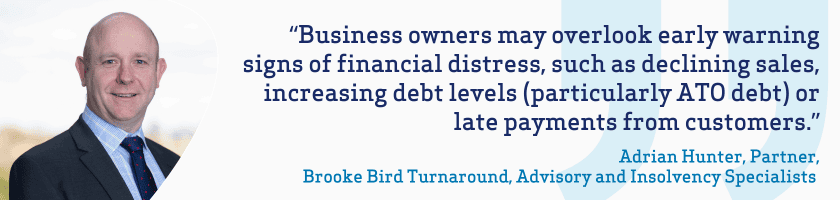
It can also mean that SMEs owners turn a blind eye to red flags. “Business owners may overlook early warning signs of financial distress, such as declining sales, increasing debt levels (particularly ATO debt) or late payments from customers,” Hunter says.
Consequently, SME owners tend to march on, often mistakenly believing they can solve significant challenges by working harder and investing more. “SME owners are, at heart, entrepreneurs,” Hunter says. “This can result in persisting in keeping the business operating, despite mounting financial and mental health pressures.
When small business hits a rough patch, some owners feel pressured to invest their own personal funds with money borrowed against the family home or personal credit cards, he cautions. Alternatively, they may be tempted to take out high interest loans from online providers.
“Over time, if the business continues to underperform, more and more money is injected until, not only will the business inevitably fail, but now the family home is at risk and personal bankruptcy is a potential,” Hunter says.
Steps for SMEs to insolvency-proof their business
Seeking expert advice before a company is in financial freefall can help get back on track.
“Many SME owners lack business or accounting skills, and may view accountants as an unnecessary expense, engaging them only for annual tax returns,” Hunter says.
“This can lead to costly mistakes. Engaging an IPA accountant early can provide valuable compliance and strategic advice throughout the business lifecycle.“
Experienced IPA accountants can diagnose problems early and recommend remedial actions.
“They also have networks of professionals, including registered liquidators, who can provide specialised turnaround advice,” Hunter says.
How can accountants help keep SMEs in the black? The first step is to help SMEs keep thorough accounts.
“The value of implementing low cost but reliable systems to capture financial data cannot be underestimated,” Bailey says.
Automated accounting software helps advisers provide timely, accurate and valuable advice. This also helps with better planning – particularly with preventing SME owners from mixing business with personal finance.
“Encourage business owners to plan their remuneration out of the business – rather than drawing [money] from time to time based on their needs, or to [benefit from] a windfall,” Bailey says. “If the business does well, additional [funds can be drawn] at the end of a trading period, but directors can rarely afford to refund the business if they overdraw unaffordable remuneration.
“[This] planned approach also [helps with meeting] legal duties that require [the] separation of personal and corporate finances and drives best practice.”
Meeting compliance obligations helps cash flow management
Once an SME has accurate accounting and planning in place, the next step is ensuring compliance deadlines are met.
“The ATO is significantly more supportive of [accommodating] companies with high standards of compliance that communicate proactively,” Bailey says. “A reputation for poor compliance is the biggest factor leading to withdrawal of support for rehabilitative measures.”
Hunter says strong compliance sets businesses up for better cash flow management.
“Advise on effective cash flow management strategies, such as negotiating better payment terms with suppliers, incentivising early payments from customers and maintaining an adequate cash reserve – which may include [setting up] a separate bank account to pay business activity statements (BAS),” Hunter says.
Maintaining regular contact to examine past performance and develop forecasts helps keep SMEs in the black.
“Encourage clients to meet at least quarterly, coinciding with BAS lodgements and year-end returns,” Hunter says. “Use these meetings to review past performance and future forecasts, addressing any issues proactively.”
Frequent financial health checks are important “to identify potential problems early and allow for adjustments before issues escalate”.
Finally, should an SME start to struggle, then intervening as soon as possible is crucial.
“If a client shows signs of financial distress, facilitate early intervention by referring them to a registered liquidator, rather than an unregistered pre-insolvency advisor,” Hunter says.
“Emphasise that early action can help rectify problems and avoid long-term failure, ensuring the client can eventually return to the IPA accountant’s care for ongoing support.”
Details about the IPA’s webinar, Taxation Aspects of Liquidations & Winding Up Companies, on 30 October HERE.