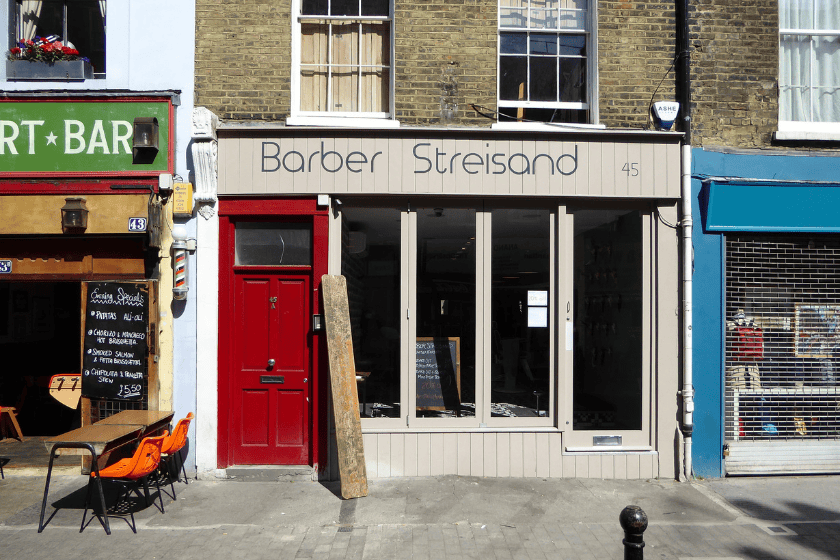
Image: “Barber Streisand” by Duncan Cumming is licenced under CC BY-NC 2.0
At a glance
- Your business name can be a powerful marketing weapon.
- A memorable business name shows a company to be imaginative and original.
- Avoid the pitfalls though – ensure your business name is easy to spell.
There are many examples of small businesses flexing their creative muscles to come up with clever names.
Hairdressing has always sparked plenty of cutting quips, such as the Blues Brothers inspired, Curl Up & Dye. Others include Shears to You, Hair Apparent and To Dye For. Some of the best-named salons in the world include Toronto’s Grateful Head and London’s Barber Streisand.
Cairns restaurant Wok Around the Clock has stood the test of time, while Melbourne restaurant Lentil as Anything previously served vegetarian until it closed its doors. Names with pizzaz do not erode brand value, especially for pet grooming business Dirty Dogs Done Dirt Cheap, nationwide waste removal service, Trailer Trash and portable loo hire group Splashdown.
Further afield, businesses trading well on witticisms include an Indian-inspired street food business in Manchester called Tikka Chance on Me, and Perky Blenders, a coffee supplier in east London.
It’s not just the company name that matters. An effective slogan can also help with marketing and clever ones are all the rage: “Now is the discount of our winter tents” has been attributed to a camping store. A pharmacy has used the ambiguous tagline: “We dispense with accuracy.” And a retail outlet selling curtains went with: “Shop in here and hang the consequences.”
Why do funny names work?
Joe Alder, head of SEO at Rocket Agency says while clever names can stick, clarity in a name was more important so customers understand what a business does. “Clarity beats clever every time,” he says.

However, witty names that gave their brands personality work well for cafes, tradies, pet services and local shops. “I wouldn’t ever recommend it for serious fields like finance, law, or health unless your brand is rock solid.”
Alder advises business owners to: test a name on strangers to establish whether it is witty, memorable and appropriate; check it is clear what you offer; and determine whether the name will grow alongside your business.
Audience should guide decisions about names. “Know your crowd,” he says. “Does witty fit them? Look at competitors – if they’re all bland, a fun name stands out. If everyone’s trying puns, play it straight.
A well-chosen and memorable moniker can spark word-of-mouth referrals and build brand personality. A name that misses the mark can confuse customers or seem unprofessional if it does not match audience expectations.
In terms of search engine optimisation (SEO), a witty name itself doesn’t magically help your Google rank, Alder cautions. “If your name happens to include good keywords (like ‘Sydney Plumbing’), that definitely helps rank,” he says.
“Some even get witty with SEO, like naming themselves ‘Best Ribs in Sydney’. But if you are doing it just for SEO without a witty angle it can come across as generic.”
Alder’s “standout Aussie examples” include:
- Lord of the Fries (vegan fries)
- Surelock Homes (locksmith)
- The Codfather (fish and chips)
- Thai Tanic
- The Pawsh Wash (dog grooming)
Workshopping a memorable business name
For Ville Vahteri, founding partner of brand agency Bou, small businesses should start by defining in one sentence what they want their target audience to think about their company, product, or service when they visualise the brand, saying: “Only after that can you evaluate how different names fit that image.”
Tom Bourlet, SEO expert and Senior Digital Marketer at The Stag Company, believes brainstorming (or should that be ‘namestorming’?) is a great way to get people thinking about potential brand names, but he asks participants to think up three to five names to bring to the meeting in order to avoid an uneasy silence at the start.
Bourlet says: “It can also help if you have a set of terms for inspiration written down. People can get pigeon-holed with these, so don’t just use industry terms. You can also look at other terms around your industry, competitor names, or inspirational and clever names.”

But don’t just consult the bigwigs in the company, warns Bourlet; try to get more people involved: “You never know who a creative idea might come from. Also, you should run the potential names by people. Do as much surveying as possible, because you want to hear potential negatives to any name you might consider.”
Ensure your name makes the right impression
Your business name is the biggest weapon in your company’s marketing armoury. As Vahteri points out: “It’s by far the most repeated term related to your brand, beyond any taglines, slogans, campaign copies or landing page headers.
“Even compared to logos, names get repeated much more as they can be written and said aloud. So, take your time to choose the right one. (And yes, you can let artificial intelligence generate thousands of potential names for you, but please don’t let it choose which one to use).”
A clever brand name with a double entendre can help to stick in a customer’s head and build an instant rapport. There is, for example, a print and digital content creator called Writers’ Bloc and a dry-cleaning business in Turnham Green, west London called Turn’em Clean. Or how about Excelerate, Capital Ideas, Safety in Numbers, or Count on Us as prospective names for accountancy firms?
| Top tips on naming your business |
|---|
| Use no more than three words. |
| Choose a name that is easy to spell. |
| Make sure the .com and, ideally, all the social channels, are available. |
| Don’t make your name too similar to other brands; doing so will place you in dangerous legal territory. |
| Think about how the logo will work with the brand name you settle on. |
| Try using prefixes and suffixes to create unique names out of ordinary words: try colours (e.g. Red Bull, Yellow Tail), category terms (e.g. MailChimp, SoundCloud), positive adjectives (e.g. Supercell, Goodreads) or participles and prepositions (e.g. Allbirds, Under Armour). |
Consider trademark laws
A significant challenge is finding a name that isn’t already trademarked or one where the domain name and social profiles aren’t already taken, so ensure potential names you come up with aren’t flagged and, ideally, offers digital media availability.
But it also pays to research other aspects of any would-be brand names. For example, check whether it has negative connotations in certain countries. When Gerber Products, a subsidiary of Nestlé since 2007, launched its baby food in France, the product is said to have underperformed. This is not surprising given the brand name is French slang for ‘to vomit’ which, of course, hampered its ability to make headway in the country.
Where do you draw the line?
There are some hard and fast rules when it comes to naming a business, according to Bourlet: “It can’t be offensive. [If it is,] you’ll have all types of issues from potential customer complaints to [possibly] being rejected for Google Ads. You need to contemplate globalisation and cross-cultural marketing; could the term you use be offensive elsewhere? Would it make sense abroad?”
A fun name is a brilliant way to increase your customer base by connecting with prospective customers in a creative way. It can certainly help attract customers but bear in mind that this will only happen if the brand can deliver an exceptional product or service that makes a difference in the market – a great name alone won’t be enough.