
At a glance:
- Governments use fiscal rules to limit their own spending, borrowing, and debt.
- However, many nations treat these rules as guidelines rather than strict requirements.
- Governments borrowed heavily for crises but have failed to save during better times.
- This has led to high debt, increasing vulnerability to future economic shocks.
Most accountants are familiar with the idea of self-imposed budget rules. Individual managers in a business, for instance, may take responsibility for meeting budgetary targets for their part of the business. They will typically have limits of some sort on how much they can spend, borrow and run up debt.
Governments are not precisely analogous to businesses. But we can still ask how governments perform when they try to impose on themselves similar sorts of “fiscal” rules? (The term “fiscal” simply refers to the spending and revenue-raising of governments.) How well do governments follow rules they themselves have designed to limit their ability to spend, borrow, run budget deficits and increase debt?
As it turns out, we now know the answer to this fiscal rules question, courtesy of the International Monetary Fund (IMF). The gloomy verdict: nations have not done that well at following their own rules.
Indeed, having imposed fiscal rules, many countries seem to treat them like the Pirate Code from the movie Pirates of the Caribbean. They are “more what you’d call guidelines than actual rules”, as the movies’ Captain Barbossa deliciously sneers. And like our pirate captain, countries frequently ignore them.
The result has been higher government debt. The governments of the world’s advanced economies now collectively owe 112% of their nations’ combined annual GDP.
As government debt rises higher in 2026, fiscal rules seem more important than ever.
The rise of fiscal rules
Many mainstream economists endorse what we might call the rainy-day rule for running government finances. That is, they think governments could effectively save for tough times by using the good times to run government surpluses. They could achieve this by spending less, taxing more, or both.
But neither option is popular with voters. So such rainy-day government saving, if any happens, is usually meagre and insufficient.
And that’s where fiscal rules come in. As a UK House of Commons Library report puts it, fiscal targets are there to encourage politicians to make “difficult choices about tax and spending”.
More countries take on rules
Number of countries with at least one fiscal rule
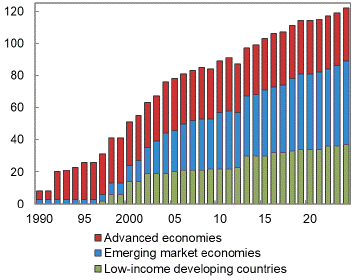
Source: Alonso and others, 2025; IMF Fiscal Rules Database 1985-2024
Fiscal rules can be used to enhance transparency and signal governments’ intentions to voters and financial markets, showing that they are committed to managing the public finances well. They can also help national treasuries to manage competing bids for increased spending or tax cuts. Effective targets can lead to lower borrowing and debt over the long term. In this way, fiscal rules can sustain public finances and give governments more freedom to act when tough times come.
More and more nations have put announced rules that they say will limit their spending, borrowing, deficits and/or debt to sensible levels. On the IMF’s count, 122 countries now have some sort of fiscal rules.
The Pirate Code approach
The IMF’s latest report on the “fiscal rules” issue sets out the problem. Like the pirates, those who impose fiscal rules on themselves often cheat. The report’s authors say that “about 40 percent of advanced economies and nearly two-thirds of emerging markets exceed their own fiscal limits”.
Over the past 20 years, nations have leant more and more heavily on fiscal measures to let them borrow and spend money, especially when unexpected problems strike. They have borrowed to stimulate economies during what the IMF describes as the “severe shocks” of the global financial crisis (2008) and the COVID pandemic (2020).
“About 40 percent of advanced economies … exceed their own fiscal limits.”
International Monetary Fund
But they have been less proficient at reining in spending again when the shocks recede. As the IMF points out, in the face of higher debt and spending pressures since COVID, more countries have broken their own rules. The IMF says two-thirds of the 123 countries with fiscal rules have changed them since COVID.
Many have introduced “escape clauses” that let them temporarily suspend rules during exceptional circumstances, such as war, severe recessions or natural disasters. In many cases, the IMF says, countries have struggled to follow even these amended rules. The escape clauses have often lacked accountability mechanisms like a requirement for a plan to return to compliance. Just as Pirates of the Caribbean puts it: “more what you’d call guidelines” …
The uncertain result
Of course, no individual can borrow indefinitely without consequences, and the same is true of governments: over time, left unaddressed, interest payments start to eat up a greater and greater share of governments’ incomes.
So far, economies have been able to run with borrowing at much higher levels than the economists of 25 years ago might have thought. But economics provides no absolute rules about just how much borrowing is too much. The economists of 25 years ago would have been shocked by many of today’s government debt levels – and we can’t say for sure that their judgment would have been wrong.
2026 seems a good time to save more: it’s now five years since the worst of the COVID pandemic. Yet in recent years, governments have rarely taken action to save substantially more between emergencies.
This was not an urgent problem while global interest rates stayed low. But now, with rates higher, countries have less ability to boost spending further. As a result, the IMF says, nations including the UK and Australia now find themselves more vulnerable to unpleasant new economic surprises.
In the films, the pirates were dead men walking. The world’s governments hope to avoid a similar fate. The IMF would like them to hope a little less and act a little more.
Learn more about how the IPA is advocating for the profession here.