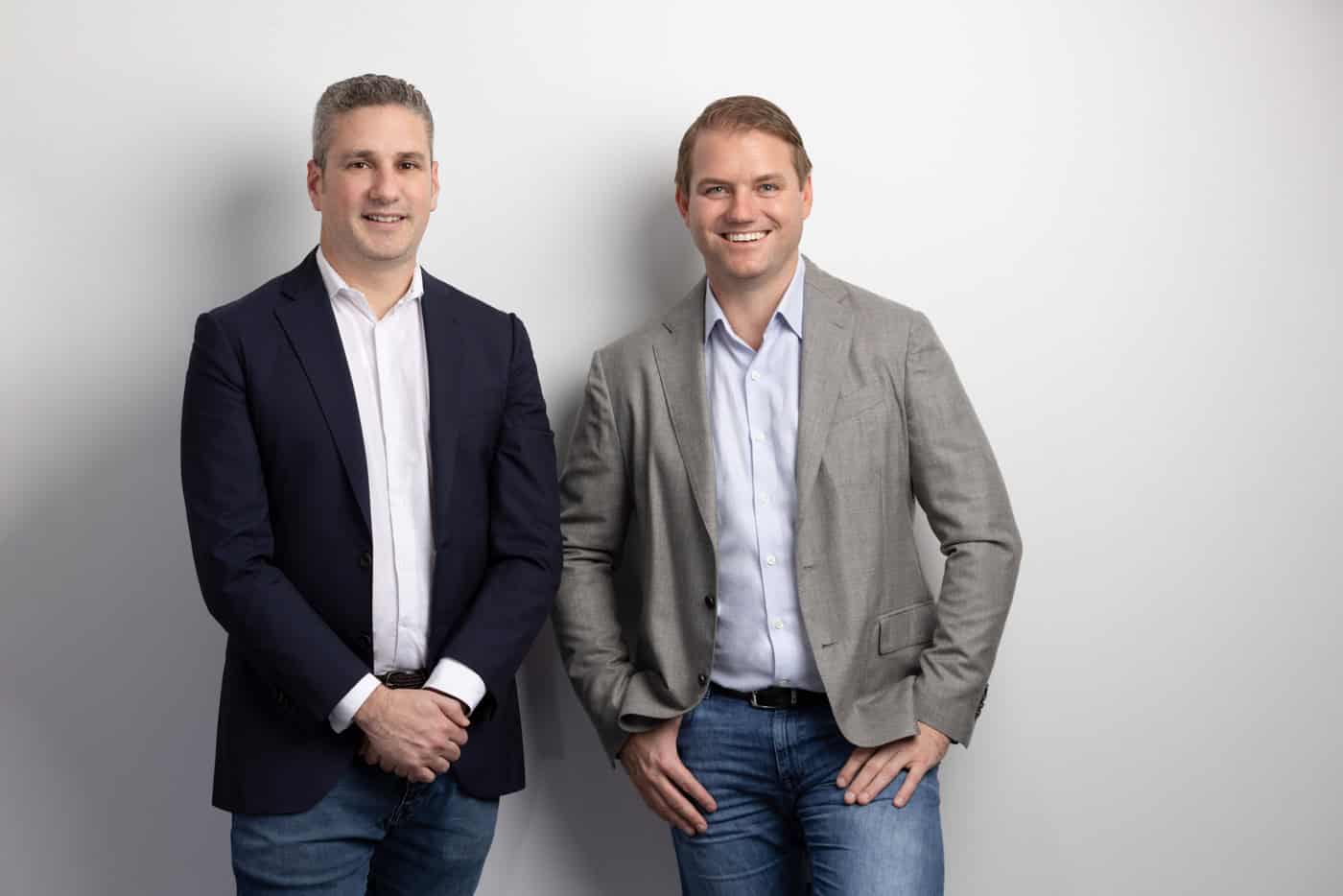
Beau Bertoli was about 20 when he started his first small business. He was in his third year at Sydney University studying for a bachelor of commerce, and was heading down the path of becoming an investment banker.
His first venture was a shop in Sydney, Moda Scooter, selling imported two-wheelers from Italy.
“It was my first experience about what it takes to run a business, and in the first three months I learned more about running a business than I did in three years at university,” he says. “I am now a massive believer in what running a small business can teach you.”
After Moda Scooters he worked in property development and set up a business selling telematics systems for fleet managers.
He then spent five years working with listed financial services company FlexiGroup before joining forces with Greg Moshal in 2012 to launch Prospa.
Mr Bertoli met Mr Moshal through a mutual friend and the two bonded over their shared experience in navigating the pitfalls of small business and finance.
Now Mr Bertoli, 38 and a father of three young children, along with partner Mr Moshal are celebrating 10 years of operation with one of the world’s biggest and most successful small-business lending organisations.
Prospa was the first of its kind in Australia – an operation dedicated solely to providing capital to small businesses. In the decade since it started it has lent nearly $3 billion to more than 35,000 small businesses, created 150,000 jobs as well as adding $10 billion to Australia’s GDP, according to their own analytics.
“The success of our business is that we have been our customers,” Mr Bertoli says.
“In my own experience as a small business owner, I needed cashflow and couldn’t get it from a bank. Like many small businesses, I had to borrow from family and friends, which is one of those things you don’t want to do.”
When Mr Moshal and Mr Bertoli came together to start Prospa they shared a goal of finding a way to get money into the hands of small businesses.
“The banks didn’t provide capital to the small business sector. Most SMEs really only want between $20,000 and $100,000 – and 97 per cent of them have a turnover of less than $2 million per year,” Mr Bertoli says.
Both he and Mr Moshal thought there had to be a better way for small business to access finance and came up with the idea of Prospa.
“The inspiration was very personal in that regard – we didn’t want to create a solution that only incrementally improved the system, we wanted to wholesale change it,” he says.
Lending money to anyone is risky and for the first couple of years, Mr Bertoli says they funded the business themselves without drawing a wage. They started with $150,000 in working capital and $200,000 in loan capital.
“We were handing out printed fliers to business owners and doing our own R&D while we were trying to get clients,” he says.
“Business owners were telling us what they needed and how difficult it was to access working capital so they could expand their business.”
He remembers vividly their very first client – a hairdresser who wanted to add a third chair to her salon.
“She wanted $14,000. It wasn’t just for the price of the chair, but the other things that go along with that, like product, utilities and staffing,” he says.
“We asked her what a third chair would do for her business and she said it would increase her revenue by 20-30 per cent per year, which was between $30,000 and $60,000. That’s a lot of extra revenue.
“She was surprised at how quickly we said yes. Banks can take up to six weeks to approve a loan and we approved it within a couple of days. She was very grateful and that gave us a lot of inspiration.
“We knew that if we could provide capital to small businesses, they could take advantage of opportunities that may arise. It’s the small stuff that can make a big difference. For example, if a 60-seat restaurant could renovate the back area of their premises and put in another 20 seats, they can increase their revenue by a sizeable amount.”
Mr Bertoli says small-business owners are making decisions everyday, just like big businesses, and know that to make money you have to spend money. But until Prospa, that was a near impossibility.
“We were just two guys with an idea and this is a business of risk,” he says.
“In the early days we didn’t know if the credit policy would be sustainable. We knew what a good business looked like and what a stressed business looked like and we built a lot of intellectual property and analytics around that side of the business.
“We leveraged off that data to build our credit model. We saw the power of data and that has been what has differentiated us [from other lenders].
“Anecdotally, when we speak to our customers and we provide them with capital, we hear that they spend, that they invest in their business, they go and create jobs, and that does fuel economic growth.
“From our own economic impact research we’ve found that for every $1 million we have lent, it has a $4 million positive impact to GDP and creates or maintains around 57 jobs.
“These are really meaningful numbers. It really is the small business economy that is powering Australia forward and creating jobs.”
Although Prospa has gone from strength to strength since 2012 – including listing on the Australian Stock Exchange in 2019 – Mr Bertoli admits there have been times when it has been stressful.
This was especially true during the pandemic, when lockdowns put the brakes on small business.
In March 2020, nine months of consistent growth came to a halt and Prospa was left with little choice but to defer loan repayments from a large chunk of its customer base.
“Like all businesses we had to find a way to work through,” he says. “In the first months of the pandemic we had clients calling for help so we made the decision to defer payments. We had around $500 million owed to us and that was a scary moment.
“But a few months into it we realised that small businesses would get through this. Small businesses learned to be adaptable and nimble and evolved their business model. It showed the strength of character of small businesses – they are resilient and make things happen.
“Small business owners have the ability to move lots of different levers and manage their cashflows carefully. And if economic times do get a little bit tougher, it is easy for small business owners to start modifying their businesses to potentially even take advantage of opportunities that come their way.”
At the height of the pandemic, when the previously bustling hospitality sector in Australia’s capitals ground to a halt, Prospa found itself servicing the growing suburban market of cafes and takeaways.
Prospa may now be one of the largest operations of its kind in Australia, but Mr Bertoli says the fundamentals of owning and running it are the same as any business, large or small.
As Prospa grew, one of the biggest lessons he had to learn was how to “let go”, he says. From a start-up of two people, it now employs 270 across Australia and New Zealand.
“Moving away from the start-up phase and becoming a scale-up forces you to come to terms with the fact that the company you spent years creating has become bigger than just you,” he said at the time, when Prospa began to gain momentum.
“For Greg and I, Prospa is our baby. But, we now have highly capable and talented teams that we have to entrust to make decisions and empower to bring their own plans to life.
“There was a stage about three years ago where I was trying to be in 50 meetings a week and was simply forced to step back. Trying to retain total control puts a cap on your ability to grow.”
And helping businesses grow is what Prospa is all about, he says.
“In Australia the flow-on effect from providing capital to small business is remarkable,” he says.
“It’s more difficult to get going than to keep going. Once you’re up and running it’s all about scale, growing the revenue faster than the costs.
“We take time to understand the circumstances downstream and the effect is difficult to quantify, but it has been beautiful to watch.”
Playing to the strength of a business is paramount and Mr Bertoli uses that lesson in his own life. He says his biggest strength is that he can set a clear vision and rally people behind it.
But he also acknowledges his weaknesses.
“I don’t tolerate fools; I have very high expectations and I’m quite demanding of my time and everyone around us. That can be something people love or find challenging,” he says.
He says there are three main pieces of advice he would give to any business – those just starting and those looking to grow.
“The first thing I recommend is to read the book, The E-myth,” he says.
“Most people go into starting their own business thinking they will create more time for themselves, have more money and more freedom, but that’s not true.
“You have to go into it knowing it for what it is and if you can break through those first two to three years then you should be OK.
“Second, always build a business plan. Put it down on paper and then go and talk it through with someone and get them to play Devil’s advocate. Eighty per cent of small businesses fail in the first two to three years because they didn’t see something in the business plan.
“Lastly, have a working capital or cashflow plan. I have never seen a business that started with a profit. Your assumptions about how much cashflow you will have will inevitably be wrong. You have to be able to plan for what will happen when you have less cash coming in because it’s hard to create cash.
“Be optimistic but tone down your expectations and double what you think you may need in regards to cash.
“I recommend that any small business operator takes a course in bookkeeping or accounting to understand the basics of profit and loss, cashflow and invoicing. Just a short course at TAFE or online. You need to know how that all works.”
And he takes seriously his own work motto.
He says: “I think it was on the front cover of the Harvard Business Review many years ago: ‘Are you coping with change or leading it?’”