At a glance
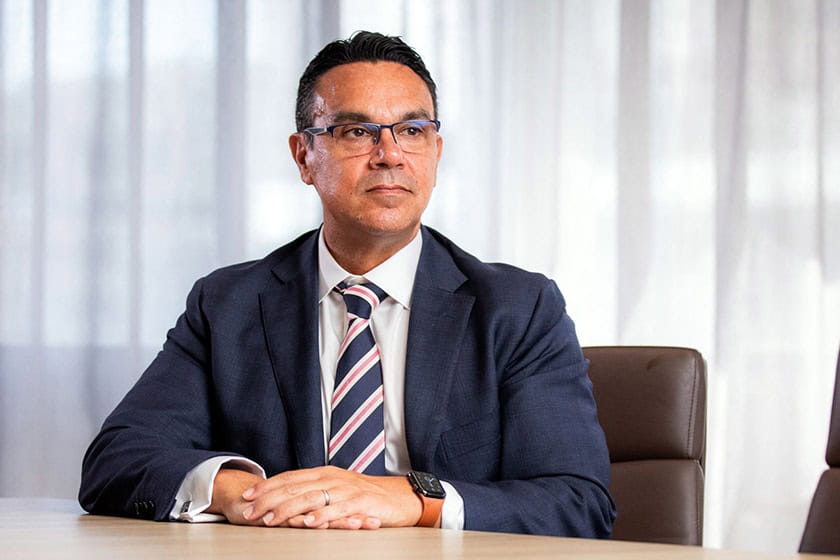
- AUSTRAC CEO Brendan Thomas is overseeing the introduction of new Tranche 2 anti-money laundering rules.
- The new rules target the flow of money from serious crimes.
- Accountants must prepare for the 2026 deadline by registering and creating an AML/CTF program.
- AUSTRAC will focus on education, not penalties, for small firms trying to comply.
During his three-decade career fighting crime and injustice, Brendan Thomas has acquired a healthy mix of criminology, legal and leadership skills.
As the CEO of the Australian Transaction Reports and Analysis Centre (AUSTRAC), he’s using them all in his organisation’s efforts to reduce money-laundering and terrorism.
AUSTRAC is the government intelligence agency responsible for detecting and disrupting financial crime. Thomas has now spent almost two years at its helm. His earlier experience is extensive: he has held executive or board roles at the NSW Department of Communities and Justice, Legal Aid NSW, the NSW Attorney-General’s crime-prevention division, the Australian Institute of Criminology and the Designing Out Crime Research Centre at the University of Technology, Sydney.
Thomas’s career has also been informed by his Indigenous heritage. He knows full well that “my people are very involved in the justice system from the other side a little bit too much”. That, he says, is why he has chosen this path. “My background has been in justice and reform and change. And bringing those elements together merges well in terms of the anti-money laundering program we’ve got at AUSTRAC.”
And his years in the field have deepened his motivation. “Anybody who works with crime knows it gets in your blood,” he says. “And you realise you can do a lot working in public policy to make the world safer and combat the bad people who are out there.”
One big current challenge in that mission is to steer AUSTRAC through the introduction of what are known as the Tranche 2 anti-money laundering and counter-terrorism financing (AML/CTF) rules. They will come into effect on 1 July 2026.
Michael Davison, the IPA’s general manager of advocacy and emerging policy, notes that we don’t know for sure how many IPA members Tranche 2 will cover. “But we suspect it’s the majority,” he adds.
The stakes of financial crime
Thomas’s talk of “bad people” and “making the world safer” may seem a little over-dramatic – until you remember how laundered money came to be what it is. The money needs laundering because it flows from crimes that scar individual lives, including drug trafficking, child exploitation, cybercrime and fraud. Other laundered funds come from bribery and corruption; yet other laundered funds have been implicated in terrorism financing.
“We’ve never penalised a small business for administrative mistakes, and we have no intention of starting now.”
– Brendan Thomas, AUSTRAC CEO
The new Tranche 2 rules are designed to put more heat on money-launderers. As part of this effort, the new rules target the professionals who help launder the money – wittingly, unwittingly, or suspecting what they are being asked to do whilst looking the other way. Many lawyers, real estate agents and dealers in precious metals and other products will now be required to identify and report suspicious business activities. And so will accountants, if they fall under the definition of “designated service providers”. Many – perhaps most – will need to do so.
Thomas concedes that many Institute of Public Accountants members and other finance professionals will view the new AML/CTF regime as “another compliance burden”. “Nobody wants extra regulation,” he says. “But we’re really tackling what is quite a significant problem in the Australian community.”
The scale of the challenge
Thomas has huge ambitions for money-laundering reductions. “We want to work collectively to make the Australian economy free from organised crime and money-laundering,” he says. “That’s what really drives me in this job.”
It’s a challenging task. Thomas and his team work in the knowledge that international efforts to minimise money-laundering and counter-terrorism financing are a long way from the goal of zero money-laundering. Indeed, as Public Accountant has noted, society has worryingly little evidence that AML/CTF efforts are even substantially reducing money laundering and terrorism financing.
A 2021 United Nations Office on Drugs and Crime report, for example, found that just 0.1% of illicit financial transactions are ultimately seized or frozen. In the United States, research suggests money-launderers face less than a 5% risk of conviction.
AUSTRAC estimates that serious and organised crime costs Australia about $68 billion a year, but Thomas will not commit to any desired targets to bring down that number. “It’s difficult to put an exact figure on it,” he says.
The recent successes
Instead, Thomas points to AUSTRAC’s successes in improving compliance with the existing AML/CTF rules. He cites the penalties won against the major banks for breaching those rules – including a $1.3 billion fine for Westpac in 2020. He notes that these are some of the biggest penalties in Australian corporate history. And he points to their knock-on effects: since these wins, he says, “banks have invested incredible amounts of technology, effort and expertise, and it’s much harder to launder money through banks than it was before.”
He also highlights some of the metrics that the watchdog analyses to gauge the success of crime-fighting programs and anti-money laundering actions.
Through AUSTRAC’s own actions and its engagement with other entities, Thomas says prosecutions are increasing against crime gangs, and criminal asset confiscations are rising. AUSTRAC’s financial intelligence has also brought a blitz on “money mule” accounts – that is, false bank accounts used to launder money – that led to more than 14,000 of those accounts being closed in 2024.
“We can see that the work we’re doing is making it harder and harder for people to launder money,” he says. “The challenge is that there’s still a lot of dirty money in the Australian economy … It’s a bit of whack-a-mole sometimes.”
Thomas draws hope from efforts to target the illicit drug market in Australia, which the Australian Criminal Intelligence Commission values at about $12.5 billion, plus the multi-billion-dollar illegal tobacco sector in Australia. “The gambling sector is also a good example of where we’ve got people to act lawfully and put in place controls. We can see a difference in the amount of money being laundered through those organisations and hopefully we’ll see a difference on the back of these Tranche 2 reforms.”
Accountants’ steps to Tranche 2
AUSTRAC believes accountants have a key role to play in the AML/CTF campaign. Thomas urges designated service providers, including accountants and their firms, to start preparing for the 1 July 2026 deadline.
As accountants get ready for Tranche 2, that preparation has several steps:
- Register. Accounting firms providing designated services under the expanded AML/CTF regime must enrol with AUSTRAC from 31 March 2026, and no later than 29 July 2026.
- Designate a fit and proper AML/CTF officer. This officer should have knowledge of all areas of the business, and have sufficient internal power to manage anti-money laundering obligations
- Maintain an AML/CTF program. This includes completing a risk assessment and outlining operational policies to manage the firm’s money-laundering and terrorism-financing risks.
- Understand requirements around suspicious matter reports. These must be sent to AUSTRAC if firms suspect that a person or transaction is linked to a crime.
Consultants: pros and cons
Thomas adds that firms should also start to train and educate staff members about the new AML/CTF requirements to ensure smooth adoption and minimise the chance of penalties for breaches. A key lesson comes from the introduction of similar rules in New Zealand in 2018: accounting firms should evaluate whether they need potentially expensive external AML/CTF specialists to assess and write their programs.
Although larger businesses could benefit from external support, Thomas believes most smaller practices can do it alone with the support of AUSTRAC’s guideline materials and starter program kits. “We’re going to provide that so small firms don’t have to go out and hire people.”
For those opting for consultants, he recommends making sure they “have some kind of track record and can validate that they’re doing a good job”.
Regardless of which option firms take, Thomas stresses that all businesses are responsible for their own compliance obligations when the new regime begins. “We’ve seen some providers who come along and say, ‘Sign up with me and I’ll make you compliant’. That won’t happen. People need to understand that you can outsource the work, but you can’t outsource your legal liability.”
Dealing with breaches
In the aftermath of huge financial penalties for Westpac and Commonwealth Bank breaches in the past, some small and medium-sized enterprises fear AUSTRAC is ready to penalise breaches zealously.
Thomas wants to allay such fears. He says AUSTRAC will take a lenient approach in the early phase of the program. And he adds that any big-stick approach to compliance is likely to target larger companies and wilful non-compliance, rather than small firms and businesses that are doing their best to follow the law.
“We take big actions only when there are potentially large areas of harm and wilful non-compliance,” he says. “For small businesses that are trying to comply with the law, they’re not going to get a sanction from us.”
AUSTRAC officers “do not have KPIs for how many people we penalise”, he adds. “So even if you’re getting it wrong, we may be able to tell you how you can do it better, or get it right. Our focus is on education and support, not punishment. We only take enforcement action when there’s deliberate or wilful non-compliance – when someone knowingly ignores the law or helps criminals move money. We’ve never penalised a small business for administrative mistakes, and we have no intention of starting now.”
The economic imperative
Thomas serves his first five-year term as CEO believing that AUSTRAC can play its part in stalling the flow of illicit funds. He sees the Tranche 2 rules as central to that. “The reality is that Australia is behind the eight ball when it comes to protecting our economy. Tranche 2 is about closing that gap.”
For accountants trying to identify such crime and ensure they comply with their AML/CTF obligations, Thomas has encouraging words.
“We’re not seeking perfection on day one with the new rules. We’re just strongly encouraging people to make their best efforts to comply. If you’re doing that, you certainly don’t have anything to fear from us.”
The IPA invites you to attend a 17 November joint webinar for members of all three accounting bodies whose services which will be brought into the AML/CTF regime in 2026. William Morris and Leeann King from AUSTRAC will address the impending compliance obligations most members in practice will have in advance of and following 1 July 2026.