
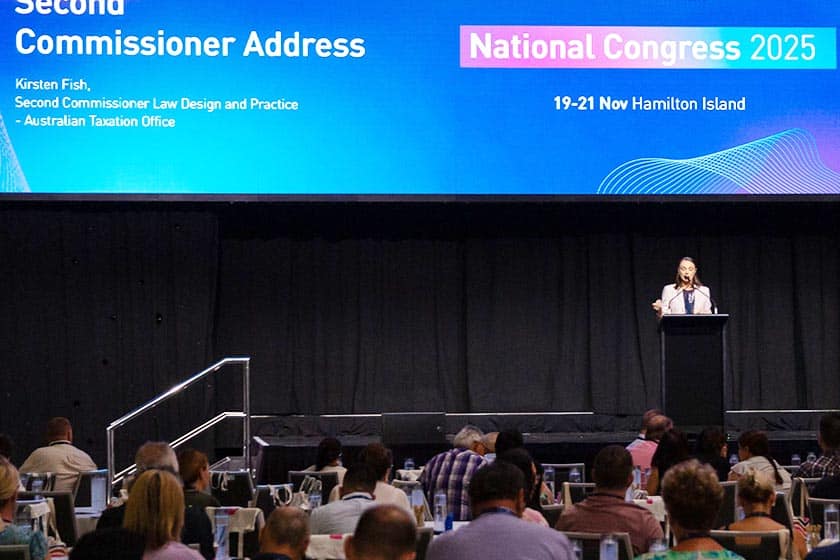
Kirsten Fish, ATO second commissioner, speaking at the IPA National Congress 2025 in November.
At a glance
- The ATO is reforming its general interest charge (GIC) remission regime after widespread complaints.
- Reforms promised for 2026 include specialist staff and improved online guidance.
- Practitioners welcome the changes but remain cautious about their real-world impact.
The Australian Taxation Office (ATO) has begun to change its interest charge remission regime, after a chorus of objections from accountants and taxpayers.
The ATO applies a general interest charge (GIC) on unpaid tax liabilities and a shortfall interest charge (SIC) on shortfall amounts, in part to encourage payment. In certain circumstances it will remit the charges – this is, reduce or waive them.
The ATO has now detailed the first of its changes to Public Accountant. This alters the process rather than the overall approach of ATO decision-making; it is not yet clear to what extent it will be seen as resolving tax agents’ concerns.
Taxpayers are clearly required to meet their obligations on time. However, the IPA and the other two major Australian accounting bodies have expressed concerns about the fairness and consistency of the ATO’s current approach.

Tax Ombudsman Ruth Owen is also conducting a review of the ATO’s approach, after her office received a wave of complaints about the ATO’s handling of the remission of the GIC. Owen has commented that the application of interest, “especially on larger debts, can very quickly make them impossible to pay back”.
First fruits of the ATO review
An ATO representative has told Public Accountant that while the ATO is continuing its review of the charges the first change will be to the process of requesting remissions of interest.
At the moment, registered agents can request remissions of interest and failure-to-lodge penalties through various channels, including phone, message and letter.
The ATO representative said that from 22 January 2026, the ATO would instead require registered agents to download and fill out new forms from the ATO website. These forms, the representative said, would need to be submitted using the Practice Mail facility in Online services for Agents (OSfA). Where agents did not have access to OSfA, information would still be accepted over the phone to complete the forms.
The ATO representative said the changes “are in response to feedback we have heard from agents and taxpayers”, and that they would ensure that:
- there is consistency in the format of the request;
- the ATO receives all the necessary information it needs to make a decision regarding the request for remission; and
- requests can be sent to and considered by a dedicated ATO team.
The ATO listed additional changes applying to “all taxpayers”. These would include “improved online guidance regarding remissions and for phone approvals of remissions above $2,500”.
Where remission requests were made by phone, requests over $2,500 would be escalated to the dedicated team referred to above, the ATO representative said.
“These changes will help us make more consistent decisions and give clearer guidance to taxpayers and tax agents,” the representative concluded. “This is an interim measure while we await the outcomes of our broader review of taxpayer relief provisions.”
The ATO announcement follows a speech to the IPA National Congress 2025 where ATO second commissioner Kirsten Fish told accountants: “rest assured, we’ve heard you”. She admitted that the tax practitioner community had expressed concerns about the “timeliness of decisions on remission requests” and “inconsistency in decision-making”.
Lacking empathy
The IPA has been among the most prominent campaigners for reforms to GIC remissions. According to IPA advisor Letty Chen, a lack of compassion from ATO agents has upset accountants. She notes the tax office has transitioned from a lenient debt-collection approach during COVID-19 to a more adversarial stance.
“So it’s one thing for taxpayers not to get a remission,” she says. “But there’s also frustration that they may get a letter from the ATO that looks like it has been generated by AI and which doesn’t show any empathy for the situation that the taxpayer is in.”
At the IPA National Congress, Fish noted that in the past financial year the ATO received more than 125,000 requests to remit GIC. It granted 76% of those requests, remitting $2.6 billion of GIC for that period.
Specifics of the ATO’s changes remain unannounced. But Fish told the IPA National Congress that those changes will meet guiding principles focused on “fairness, conditionality, context, engagement and transparency”. The new measures will include “improving online guidance, introducing standardised application forms, limiting phone approvals to $2500, transitioning agent remission requests to Online Services for Agents, and establishing a specialised workforce to manage remission applications”.
IPA makes its case
In a submission to the Tax Ombudsman’s review, the IPA has documented members’ “widespread discontent” with the ATO’s management of GIC remissions. This includes:
- failure to acknowledge unforeseen and unfortunate circumstances – such as serious health conditions, or the death of a spouse – which are no fault of the taxpayer’s
- inconsistency with decisions to grant or deny remission requests between taxpayers with similar circumstances
- a lack of transparency and communication in relation to the specific reasons for a denied request for remission.
Vincent Licciardi, a tax partner at HWLE Lawyers, says the ATO’s GIC crackdown is causing considerable distress for affected clients, some of whom have not fully recovered financially from the pandemic.
“My main concern is that clients … will stop engaging with the ATO because the GIC component has gotten out of hand.”
Vincent Licciardi
He says lawyers are frustrated that comprehensive submissions for the remission of GIC are often rejected with little or no meaningful justification from the ATO, adding that lawyers would welcome ATO officers asking for more information rather than declining requests without contact. “That would be very beneficial for both sides.”
Licciardi adds that it has become cost prohibitive for many taxpayers to fight the ATO, as the only technical recourse available is to appeal in the Federal Court of Australia. “But you’re not going to throw lawyers at the problem to try to save $20,000 or $30,000 in GIC because you’ll burn that, and likely more, just getting to court.”
Specialists welcome
Licciardi and Chen both endorse the ATO’s plan to introduce a specialist group of officers who are highly trained in GIC remissions. “That would be a fantastic step forward,” Licciardi says.
The call for specialist officers comes after Tax Ombudsman findings from its recent review of the ATO’s registered agent phone line. The review found that tax practitioners are increasingly dissatisfied with the ATO and its poor service.
Of particular concern is that many agents’ calls are directed to outsourced call centre officers who have minimal experience and very little technical tax training. This leads to inconsistent and inaccurate advice, as well as delays as matters are escalated to experienced staff.
Owen touched on this problem at the IPA National Congress, citing systemic issues with the ATO’s phone helpline during the past two years and suggesting that the issue is a symptom of a wider lament whereby tax practitioners do not feel valued or respected.
On a more positive note, she acknowledged the concurrent GIC reviews that her team and the ATO are conducting and hoped that “our recommendations and findings will align”.
On the Reddit online forum, accountants have also been forthright in expressing their frustration with GIC management, with one commenting that the ATO’s recent hardline stance, including for clients with dementia and serious illnesses, has been “beyond unreasonable”. The distress had prompted him to consider quitting the accounting profession.
Others on the forum suggest there is “zero empathy” from the ATO and that it has been “robodebtifying all its systems”.
Wait and see
Taxpayers, accountants and lawyers now await further updates on the ATO changes. But Licciardi says he is worried that taxpayers will give up if they continue to face interest blowouts, because of high compound interest rates that can make tax liabilities “insurmountable”. “My main concern is that clients in this position will stop engaging with the ATO because the GIC component has gotten out of hand,” he says.
Licciardi supports an amnesty of 12 to 18 months whereby taxpayers can engage with the ATO to pay off primary debt without having to meet interest charges.
While the jury is out on the upcoming changes, Chen says the IPA is hoping that the planned changes will streamline and clarify the process for tax agents. She welcomes the move to improve transparency and clarity around GIC remission guidelines.
“We’re encouraged that they have acknowledged the complaints,” she says. “It will probably take a few months to really see what difference it makes, but change is long overdue.”
Interested in bolstering your strategic advisory skillset? The IPA Program is designed with that in mind. Learn more here.















