
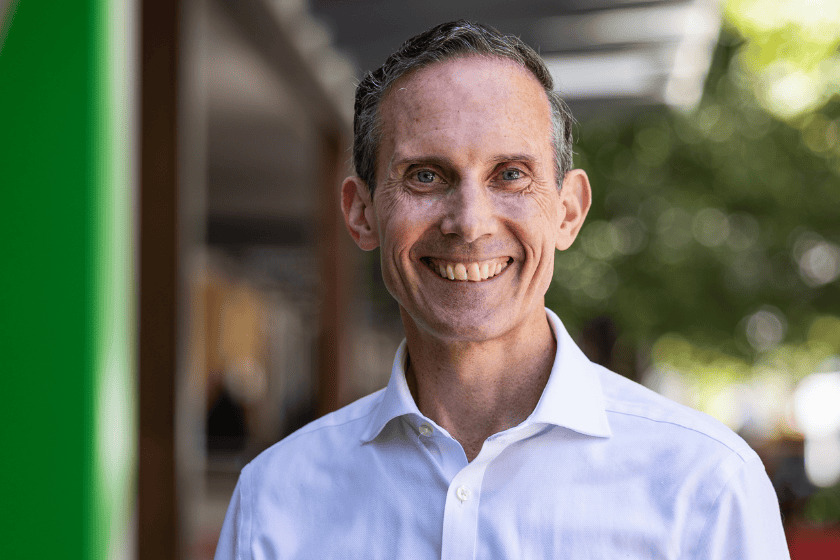
At a glance
- Andrew Leigh is an unusually influential assistant minister in a usually minor role.
- A former academic, he is known for his pragmatism and prolific writing.
- His refusal to join a major party faction has stalled his ministerial career.
- He champions a progressive supply-side agenda focused on competition and productivity.
It may be that Andrew Leigh is the most influential assistant minister in the history of the position.
Assistant ministries were only created in the late 1980s under prime minister Bob Hawke. They have mostly worked to keep ambitious but disappointed would-be ministers occupied with government’s less important tasks. Assistant ministers give speeches the minister doesn’t want to give. They deal with small problems the minister doesn’t rate as vital. They stand in.
But as assistant minister first for competition and now also for productivity, Andrew Leigh has done something unusual: he has helped to bring a new focus to the task of economic reform.
How did an assistant minister do that?
1. The pragmatist
Back in 2006, as a rising 34-year-old ANU economics professor, Andrew Leigh was walking down Melbourne’s Grattan Street when he came across a $20 bill lying on the footpath.
This was kind of astonishing. Jokes have long been told about exactly this situation. The jokes all aim to make economics look stupid. They usually have the economics professor turning to his companion and saying: “No need to pick it up; it can’t be a $20 note. If it were, someone would have picked it up already.” In some versions of the story, the economist is economics giant Milton Friedman.
Andrew Leigh, without a moment’s hesitation, bent down and picked up the $20 note.
For a former economics professor, he is a pretty practical bloke.
2. Destined for academia?
As an academic, Leigh was a natural. Before he turned 40, his CV groaned with publications. Read it, and you may start to question whether you have done enough with your life. He has authored or co-authored more than 100 journal articles and at least a dozen books. Says fellow economist and frequent Labor adviser Nicholas Gruen: “He writes books like most people breathe.”
Leigh’s subjects span quite a range – from the economics of gun buybacks (Leigh found they work), to whether a higher minimum wage can cut employment (Leigh’s answer was yes), to the methodologies of randomised trials (Leigh wants more of them.
Of the many themes in that CV’s 17 pages, one notable one is the gifts we get from our parents. Leigh has written about how much our income is likely to be like those of our predecessors. (His answer to this: a lot in the US, much less in Scandinavia, with Australia somewhere between the two.) He has written not just about inheritance taxes, but also about genetic inheritance – among other places, in a paper that found good-looking politicians get more votes.
“We’ve left the supply-side agenda to the right for much of the past generation…”
Andrew Leigh
Leigh seems intensely aware of how much his own family gave him – not in money, but in the attitudes which have driven his success. He still recounts the story of their meeting (at Melbourne’s Ivanhoe Methodist Church) with obvious delight. His mother and father both carved out academic careers, in environmental anthropology and political science respectively.
In the 1970s his parents returned from a stint in Borneo to settle in a Federation house in Sydney’s leafy Pennant Hills. They filled it with reading matter, devoting one whole room to books. Leigh recalls a much younger Andrew often grabbing one to read under a gum tree in the back yard. Most were fiction, he says, from Salman Rushdie to Shakespeare.
3. The glittering prizes
Economics was Leigh’s second discipline, his third career and his fourth degree. He worked as a lawyer for Minter Ellison in Sydney and Clifford Chance in London before a year as associate (a sort of general assistant) to the High Court’s Michael Kirby, of whom he remains a fan. Then followed a couple of years as adviser to former Labor trade minister Peter Cook, and soon thereafter, a glittering career as an economics academic.
In 2011 he won the Economic Society of Australia’s Young Economist Award for the best Australian economist under 40.
And yet by then he had already decided he preferred a political career.
4. The Methodist influence
Leigh’s political history show no evidence of radicalism. Indeed, it bears more of an imprint of his parents’ Methodist faith. Today membership of “the moderate left” is often treated as if it were a sort of soft communism. But Leigh exemplifies a Methodist left tradition that began well before Marx. British Methodists argued for a more equitable social and economic system as long ago as the 1700s. But rather than revolution, they tended to favour evolution. Rather than militant social upheaval, they urged charity and service.
Though Leigh isn’t obviously religious, that Methodist ethic shines through. “I’m enough of an economist to see the strength of the market and recognise the value of social democracy,” he says. What he really admires about the Methodist tradition is “that the adherence to principle, the notion that you should do the right thing even if no one’s watching – and that a life of service to others is the life well-lived.”
5. Playing politics
Leigh joined the Australian Labor Party in 1991, attended a lot of branch meetings, and impressed a lot of people. Endearingly, he smiles almost all the time. Along with his ability to put complicated matters in simple language, that has always tended to reassure people that he is more than just some dour academic. In 2010 he won preselection for a reliably Labor ACT-based federal seat.
Yet since 2013, he has circled in the outer reaches of Labor’s ministry, as a parliamentary secretary or assistant minister or shadow minister for charities and not-for-profits, without ever landing in a ministry proper.
Some think that unfair. No one doubts Leigh is hellishly smart and pretty likeable, and most rate him a good media performer with a special talent for putting complex matters in simple language. So why has he never become a minister?
The short answer is that Leigh refuses to join either of the ALP’s two big factions, the Left and the Right. (In a 2023 speech he set out why their “duopoly” has become unhealthy.) Those two each caucus internally and agree who they will contribute to a Labor ministry. Leigh, as a member of neither faction, gets passed over.

Most people conclude from this that Leigh demonstrates the evils of the factional system. The slightly longer answer is that the factional system has both helped and hindered him. Labor’s factions certainly do make key decisions about who gets ministries – and before that, who gets seats. But ACT Labor has its own special politics, and Leigh won his ACT preselection as a member of ACT Labor’s “independent” faction. Joining this independent faction gained Leigh his parliamentary seat; it just can’t gain him a ministry. He might once have joined a third faction, the centre-left, but that no longer exists.
6. The Not Treasurer
Factional issues aside, though, it’s also true that Leigh’s political instincts were forged quite late. Yes, he spent a lot of time in branch meetings, and he worked for a Labor minister in his twenties. Contrast him with Jim Chalmers, who submerged himself in politics from his university days: Chalmers wrote his political science PhD thesis on Paul Keating’s prime ministership, then worked for a succession of politicians culminating in Wayne Swan as treasurer, before becoming an MP himself.
A career such as Chalmers’ sharpens political instincts in a way that is hard to replicate if, as Leigh did, you spend the bulk of your formative years in law and academic economics. Leigh himself admits he has had to retain both to work in the intense group environment of politics, and to sometimes speak with less intellectual intensity.
Leigh also has company as an economic expert outside Labor’s core ministry. Labor’s MPs include not one but three economics PhDs – Leigh, assistant treasurer Daniel Mulino, and Paramatta-based Andrew Charlton, a former Kevin Rudd advisor who co-authored a book with economics Nobel-winner Joseph Stiglitz.
And anyway, the federal parliamentary history of Labor economics experts is … well, a little variable. The first trained economist to become a Labor treasurer, John Kerin in 1991, was trampled underfoot in an epic leadership battle. (His confidence destroyed by Keating, Kerin tried to escape a disastrous press conference by walking through a door to … a closet. In full view of network television cameras.)
Nicholas Gruen believes that Leigh “is having influence, and he’s doing his job”. But he adds: “Academic credentials are not that important for the job … Just because he’s got a better academic CV, he’s not necessarily a better treasurer.
“The party rooms of both major parties are places of power. That’s how you get a job. You project power, not credentials.”
Leigh makes people like him. He seems honest and upright. He just doesn’t scare people much.
7. Seeking business dynamism
When Leigh became assistant minister for productivity in 2022’s first Albanese government, he quickly focused on problems close to the hearts of small and medium business. How do we turn more of our smaller businesses into bigger businesses? Leigh told Public Accountant in early 2025 that a revitalisation of competition policy in the 2020s offered just as big a payoff as the earlier 1990s competition reforms produced. That seemed an inflated assessment. But the first-term reforms he drove, including tougher merger rules, became an important part of Labor’s 2025 economic pitch.
Perhaps aware that his economic achievements were so far not the stuff of legend, in May 2025 the re-elected Albanese handed Leigh an extra job: assistant minister for productivity. That gave Leigh, even as a mere assistant minister, a huge canvas. In the economist Paul Krugman’s phrase, for a national economy, “productivity isn’t everything, but in the long run it is almost everything”.
“I’m very confident that Andrew Leigh has the mandate among the treasury ministers and from the treasurer to pursue the agenda that he’s pursuing.”
Michael Brennan
Leigh has splashed a lot of paint on that canvas, and to noticeable effect. Treasurer Jim Chalmers confirmed to veteran Canberra commentator Michell Grattan in May that Leigh had talked him into reading Abundance. a new account of how the US left’s regulatory instincts have created a country which can’t build needed new houses or power lines to support its ambitions on migration levels and green electricity. That abundance philosophy seems to have influenced several Albanese Cabinet members, including Chalmers, to talk more about cutting red tape.
Then in June, Leigh went even further, with a speech tearing into “thickets of regulation” and “cultures of risk aversion” which he said were holding the country back.
Leigh tells Public Accountant: “We’ve left the supply-side agenda to the right for much of the past generation … A progressive supply-side agenda really matters in terms of delivering for low and middle income people who would like cheaper energy, more homes, more opportunities to see the world, more opportunities to be able to switch to different jobs.
“So we do need a progressive supply-side agenda, and tackling the overlap of regulation which has driven up the cost of housing and presents challenges to the renewables roll-out.”
And now productivity itself has become – at least for the moment – the government’s main economic focus, with August’s high-powered three-day government roundtable.
But suggest that Labor’s second-term agenda has become Leigh-shaped, and he shies away: “I think that would be much, much too … put much too, much too much on my shoulders.”
8. Settling for influence
Given Leigh’s hostility to factions, it’s not clear he’ll ever rise higher in a Labor government than he is right now. But for an assistant minister, he does seems to be doing some serious policy lifting.
That is partly because Chalmers seems to have given him a broad licence. Says Michael Brennan, the well-connected head of the e61 think-tank and former Productivity Commission chair: “I’m very confident that Andrew Leigh has the mandate among the treasury ministers and from the treasurer to pursue the agenda that he’s pursuing.”
The veteran political commentator Michelle Grattan agrees he is arguably the most influential assistant minister in the decades since the role began. She adds: “He’d certainly be the most policy-active of them, I would think”.
Leigh will likely never be a treasurer, let alone a Paul Keating. As it turns out, perhaps he doesn’t have to be.
* David Walker is a former member of the Canberra Press Gallery and the editor of Public Accountant.
Find out more about how the IPA is advocating on behalf of the accounting profession and their clients here.















