For those working in accounting at any level, AI represents much more than just a new technological offering. It’s also an opportunity to fast-track a career, says Stuart Martin, Hays Recruitment ANZ Business Director and Accounting and Finance lead.
“First of all, think about current global ESG reporting requirements,” Martin says. “Governments have mandated rules and processes around that, and every organisation is frantically trying to learn about it and scope it out. If you’re a candidate with expertise in that space, you can very quickly rise to the top of your field by simply being good at it.”
The same could likely happen with AI, he says. Not only is it new and of value to the market, but there are not many accountants who have deep knowledge of AI.

This is a great opportunity for accountants, no matter how long they have or haven’t been in the workforce, to leap ahead in their careers very quickly by adding value with system implementations and automations.
“We are seeing a massive demand for candidates who have implemented Power BI, Dynamics and other automations, as organisations can see the benefit,” he says. “Candidates that have led/run these implementations have advanced their career beyond their years of service.”
Finance professionals are early adopters
Of course, finance and accounting businesses that take advantage of automation and AI driven technologies will also earn a competitive advantage over others, Martin says. And accountants are no strangers to such innovation.
“Accountants have been early adopters of automation for years,” he says.
“In AI, we’re very much in the early days. If you look at Power BI, which is not a purely AI tool but draws on automation and machine learning and other artificial and data intelligence, it is being proactively used in the accounting space and has been for a few years.”
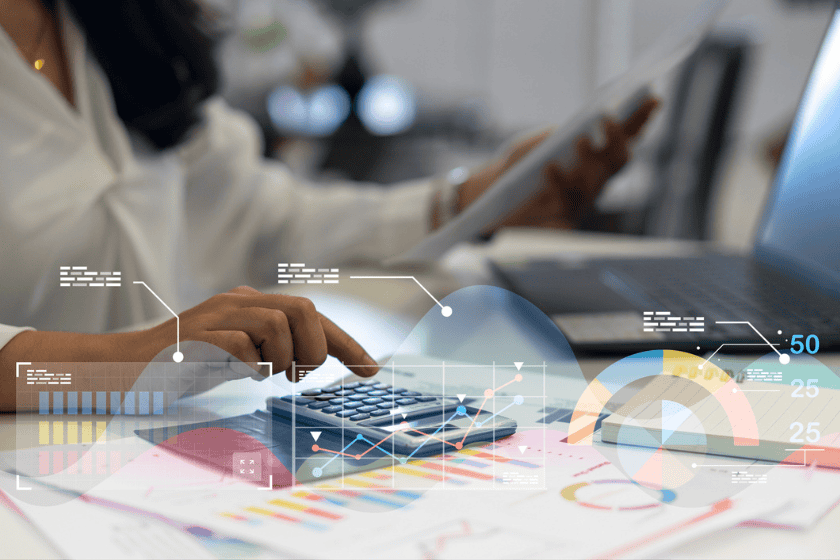
In essence, Power BI takes data and turns it into graphics that are much more easily interpreted than tables filled with numbers.
“It’s not about becoming an AI engineer. It’s simply about understanding AI enough to be able to confidently use it to maximise your existing skills.”
Stuart Martin, Business Director and Accounting and Finance lead, Hays Recruitment ANZ
“It goes in and gets the data you need and pushes it out as a visual,” Martin says. “It’s excellent for accountants because it helps them to communicate clearly and quickly. It translates their knowledge and data into a form that is more valuable to more stakeholders.”
“Within most businesses, accountants are the masters of information and data. That’s why progressive finance people are developing their own automation and technology practices.”
Such technology is having a positive effect on accounting businesses that are bringing it on board. Martin says he has seen several cases where month-end processes that once took two to three weeks now take just a few days, reducing compliance time and enabling staff to focus on higher-value tasks, as well as relationship building with clients and stakeholders.
Where do finance professionals need to skill up?
Timothy Miller, a Professor of Artificial Intelligence in the School of Electrical Engineering and Computer Science at The University of Queensland, often runs courses for businesses and industry groups looking to skill up in AI.
Some businesses, he says, are not quite sure where to start. Others have a head start as they have a person, or people, who are already championing AI within the organisation.
“I typically help to demystify it all, because AI is not magic. It’s not a brain and it’s not taking over the world,” Miller says. “It sometimes works and it sometimes fails, and when it does fail, it’s really helpful if somebody in the organisation knows why it went wrong.”
There is a mindset shift, of sorts, required when a business begins employing AI to help with the work. It has to do with trust, Miller says.
“There are still a lot of trust issues around AI, and I think that’s good,” he says. “You do need a healthy level of scepticism around these tools. So, I think a very important part of training has to be around demystifying. AI is just mostly about statistics plus computing.”
“When it fails, people need to know which part of their work they need to check. That’s all.”

While some people think AI is constantly leaping forward, and anything they learn will soon be out of date, that’s not typically the case, Miller says. While every now and then a game-changing iteration of the technology comes along, such as ChatGPT and its large language modelling, those tools won’t just disappear if another breakthrough is made.
And so, short courses offered by universities can be helpful as a starting point into a better understanding of AI, as are those offered by accounting associations, Martin says.
“It’s not about becoming an AI engineer,” Martin says. “It’s simply about understanding AI enough to be able to confidently use it to maximise your existing skills.”
AI brings more humanity, not less
As AI takes over more of the repetitive and sometimes less engaging work, it can enable accountants to focus more deeply on more human work.
Rather than presenting the numbers for the month, AI might enable accountants more time and better tools to engender a powerful understanding in those being presented with those numbers.
“Rather than saying, ‘Here are the figures for the month’, accountants are more likely to be saying, ‘Let’s talk through the story behind these numbers, and what they mean for the future’,” Martin says.
Miller agrees. “We’re not going to leave leadership up to machines,” he says. “There will always be human skills worth developing.”
And so, as AI plays an increasing role in the work of an accountant, it’s also worth considering formal education, mentoring or other methods to continue to improve one’s human skills.
Communication, critical thinking and problem solving, etc., will become more vital than ever as AI elevates, rather than eliminates, the role of the accountant.
The IPA’s AI for Accountants short course introduces accountants to the AI basics to apply to practices or clients through real-world examples and interactive discussions on 30 June. More information here.