As the largest bait wholesaler in Australia, Tweed Bait faces a difficult challenge because it distributes plastic products that are unwrapped near our waterways. As such, the business has a deep interest in the maintaining the health of our coastlines, and keeping them free of plastic waste.
According to the National Plastics Plan 2021, by 2050, plastics will outweigh fish in our oceans.
One million tonnes of Australia’s annual plastic consumption is single-use plastic, and around 130,000 tonnes of plastics leak into Australia’s marine environments every year.
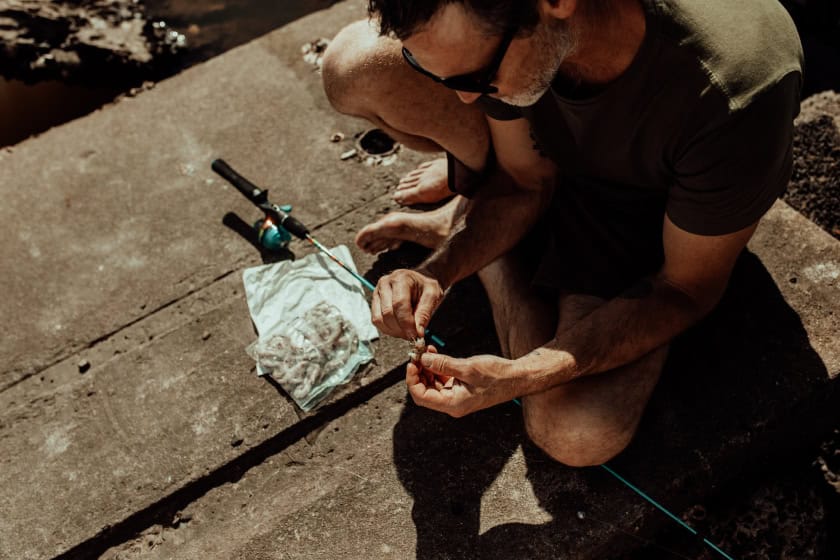
Bait, of course, is wrapped in plastic. That’s because people who fish like to be able to see what they’re buying. If it’s packaged in cardboard or some other non-transparent casing, they’ll tear it open to check what’s inside before considering a purchase, or they’ll move on to another brand.
Tweed Bait has spent several years searching for a solution and, thanks to a research partnership with the University of Queensland, might have finally found it.
This method of problem-solving has impacts that go beyond Tweed Bait’s 50-person team.
The IPA-Deakin University SME Research Centre’s most recent publication looked at policy settings that could boost Australia’s post-COVID economy, and found that support for the utilisation of Australia’s research capabilities will not just help the businesses involved, but also help the economy as a whole.
“We believe that a key source of Australia’s insipid performance on private sector innovation and efficiency since the start of this century has been the failure of businesses to tap into the strong research culture in the nation’s world-class universities and other government-funded research institutions,” the report says.
The Tweed Bait solution
“Over many years we’ve tried different types of biodegradable materials,” says Matt Poile, General Manager of Tweed Bait. “A lot of the materials we have tested have not been suitable for one reason or another. They either don’t work with our storage requirements or they’re not suitable for the way we process our baits.”
“Some that we’ve trialled don’t have enough longevity, and others don’t break down in a marine environment, meaning they add to the microplastics problem.”
As the business was working on a solution to another challenge – a highly contagious infection affecting crustaceans like prawns and crabs – it came across a program called Innovation Connections, that’s designed to help innovative research.
“We thought it might be a good opportunity to go down the avenue of partnering with a research team to look at the possibility of developing novel, biodegradable packaging for our products,” Poile says.
“A contact through that program connected us with the University of Queensland, where quite a few studies were being conducted in that field. After a few years, the first phase of the program, to find a suitable bioplastic and test its biodegradable properties in a marine environment, has now finished.
“We had really good results, and we’ve just begun phase two of the program, which is to test the material in our manufacturing facility.”
Research needn’t break the bank
Half of Tweed Bait’s research costs were covered by a government grant.
There are numerous other stories of small businesses partnering with research institutions such as universities, to boost their offerings.
Hunter Heritage Gourmet Foods identified a growth opportunity in Christmas puddings for people with intolerances and allergies to typical ingredients. The business received a Graduate Placement Grant that enabled the employment of a graduate of Food Science & Human Nutrition. The business was also linked with the Food Innovation Laboratories at the University of Newcastle.
The outcome was a vegan Christmas product that was adopted by one large supermarket chain, as well as two other products.
Custom boat builder Steber International has partnered with the University of Newcastle and electrical engineering business Ampcontrol to develop hybrid diesel/electric power systems. Two Innovation Connections grants helped fund this research, resulting in the successful launch of a prototype vessel and the continuing development of the technology.
“The project has the potential to boost jobs in regional NSW and we encourage all levels of government to support the next phases of ongoing R&D, marketing and commercialisation,” General Manager Alan Steber said.
And independent beer, cider and spirits producer Young Henrys is working with the University of Technology Sydney on the Algae Project, to decarbonise the art of beer brewing. With CO2 a major by-product of the brewing process, and algae producing more than 50% of the world’s oxygen, the partnership is exploring ways algae can be utilised in that process.
“We capture CO2 off the top of the beer fermenter and we feed it through a bioreactor which houses micro-algae,” says Oscar McMahon, one of the co-founders of Young Henrys.
“Brewers’ yeast eats sugar and creates CO2 and alcohol. Micro-algae eats CO2, creates more algae and releases oxygen. So they become these yin and yang organisms that naturally balance each other out.”
Phase two of this research is taking the idea of reusing brewing by-products to reduce or offset emissions further, exploring whether spent grain from the brewery, if fed to cows, might reduce the methane being released by those cows.
For small businesses looking to solve wicked problems, the solutions might be found in collaborative research partnerships that also create economy-wide benefits.
Download the IPA Deakin Small Business Whitepaper: Post-COVID Policy Options to Enhance Australia’s Innovation Capabilities.