In 2013 – more than a decade after the corporation was founded – it had still not attracted any funding. And, as Collard knew only too well, funding was crucial if Hotham River was to help create a sustainable future and build ongoing businesses for its Nyoongar people, whose traditional lands stretch across a vast tract of south-west Western Australia.
Collard assessed the strengths and weaknesses of his board and identified the skill shortages that were holding it back. Then he approached the Institute of Public Accountants with a request for help.
“What we are trying to do is regain a bit of control,” Collard tells Public Accountant. “W]e are making sure that we don’t lose our identity – we have been here for a long time. We advocate for our people, and to do that, we have looked at whether we have good governance.”
Making a micro-board
The IPA saw the Hotham River group as a potential and worthy candidate to get advice from a micro-board on governance, under the umbrella of the IPA’s corporate social responsibility program.
By mid-2014, Hotham River’s microboard was formed. It represents the fi rst trial of an initiative that the IPA plans to replicate elsewhere.
Micro-boards are made up of a small number of expert volunteers. From Collard’s perspective, the Hotham River micro-board’s purpose is to educate and inform directors about the best way to refi ne their goals, lift their standards and polish their plans to a point where sponsors “are going to want to come us, rather than us go to them”.
He also stresses that microboards should only be a temporary measure, meaning there should be a fi xed end date when Hotham River will be ready to go it alone.
Three Perth-based IPA members volunteered for the inaugural Hotham River micro-board. They have complementary professional histories: Troy Williams, consultant and member of the Governance Institute of Australia; Ric West, chief fi nancial offi cer at Central Desert Native Title Services; and Lisa Galatis, assistant accountant at Radlink Communications.
Shared values
Williams says one of the main issues faced by Hotham River (and similar groups) revolved around a lack of knowledge of how to apply traditional governance frameworks and how this is crucial to winning much-needed funding.
In the short time it has been involved with Hotham River, the micro-board has broadened the organisation’s understanding of the shared-values concept – this, explains West, is fundamental to modern-day corporate social responsibility and helps the board to demonstrate how its plans align with the needs of potential sponsors. Hotham River, he adds, now takes a systematic approach to decisionmaking and plans strategically for the long term.
“With not-for-profits, there is often an expectation that people will just give you money, but it’s about understanding shared values,” says West. “If the group goes to Variety Club, for example, it needs to know what Variety Club is about, what the club wants and where it gets its donations. How does [Hotham River] help Variety Club satisfy its donors? It has to be about them, not just about you.”
Early runs on the board
Since joining forces with the micro-board, the Hotham River Nyoongar Aboriginal Corporation has already seen results, coming to an in-principle agreement with gold mining giant Newmont to help relocate a building if the group’s bid with the Shire is successful. It’s a signifi cant advance from just a few months ago.
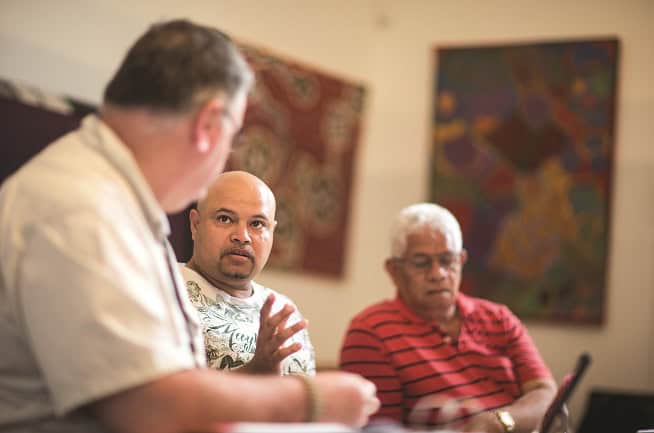
“When we went in, we were very open and transparent,” says Williams. “It’s Hotham River’s community and their board. We used our experience to help meetings – agendas and timeframes are very important. We had a meeting recently that lasted just an hour and a half, whereas earlier ones went for four hours. Also, when there are setbacks, they don’t take it personally like they used to. They are getting resilient.”
For West, it’s about establishing patterns of behaviour to encourage success. “Everyone is a beginner in this; everyone is enthusiastic and full of promise,” he says, adding that Hotham River is “very keen to get this right. This is one of the world’s longest-living cultures, and they have their sights on the next 40,000 years.”
As for Collard, a successful trial is about even more than Hotham River. “If it works, it will be a model for the American Indians, the Canadian Indians, the New Zealand Maoris,” he says. “I want to show that Aboriginal governance works – and not just for Aboriginal Australia.”
What is a micro-board?
A micro-board is a non-profit society of family and friends, committed to knowing a person, supporting that person and having a volunteer (unpaid) reciprocal relationship with that person. Some micro-boards become the entity through which paid services and supports are provided. Involvement, caring and standing by the person are valued over technical expertise. A micro-board is more than an informal advisory board or mentoring system. The board is based around a small, incorporated company structure and has final say over key decisions. It acts like a not-forprofit association, though it is not a charity. The board has a constitution and annual general meeting, and directors are subject to the Corporations Act 2001. It is based on reciprocal relationships between the directors and the individual. For the IPA, a micro-board may be established for an individual or business by engaging with a number of people with a range of skill sets that could help the individual or business develop. This skill set may come via expressions of interest from within current and/or retired members. It is critical that the micro-board members are volunteering their time and eff ort and have no financial expectations or conflicts of interest.